 Steak](https://file-host.link/website/7brown-injpl7/assets/refined-images/1781167778212000_2133c8eabee540fcb61ee2a167f4f8b2/360.webp)
Many home cooks ruin cowboy ribeyes by guessing doneness visually or cooking straight from the refrigerator. Unlike thinner steaks, a 2–3 inch cut doesn't forgive improvisation. Success requires deliberate technique: the right equipment, precise temperature management, and an understanding of how heat moves through thick meat.
This guide covers exactly what you need to cook a cowboy ribeye correctly: essential equipment, the step-by-step sear-then-oven method, the variables that determine your result, common mistakes that ruin steaks, and alternative techniques for different setups.
Key Takeaways
- A cowboy ribeye is a bone-in ribeye cut 2–3 inches thick, requiring longer cook times and precise temperature control
- Bring the steak to room temperature for 30–40 minutes before cooking, and always use a meat thermometer — thick cuts hide underdone centers
- The sear-then-oven method (or reverse sear) produces the most reliable, even doneness throughout
- Pull the steak 5°F below your target temperature and rest for at least 10 minutes before slicing
- Starting with well-marbled, 14-day dry-aged beef — like 7 Brown Farms' 100% American Black Angus cowboy ribeye — is the single biggest factor in your final result
What You Need Before You Start
Preparation directly determines whether your cowboy ribeye turns out perfectly or becomes an expensive mistake. A thick-cut steak is not forgiving if you skip the setup steps.
Before you fire up the heat, two steps matter most:
- Thaw in the refrigerator for at least 24 hours if frozen. Cooking from frozen pushes the exterior past done before the center is safe.
- Rest at room temperature for 30–40 minutes before cooking. Serious Eats testing found that even a modest temperature rise at the core allows heat to distribute more evenly edge to center on a 2–3 inch steak—reducing the risk of an overdone crust and underdone middle.
Equipment Required
You'll need:
- Heavy cast iron skillet (preferred) or oven-safe pan
- Instant-read or probe meat thermometer (non-negotiable)
- Tongs (never a fork—piercing releases juices)
- Aluminum foil for resting
- Wire rack over a baking sheet (optional, for oven finishing)
Choosing Your Cowboy Ribeye
Look for these quality markers:
- Thickness of at least 2 inches (preferably 2.5–3 inches for classic cowboy ribeye presentation)
- Visible intramuscular fat marbling throughout (not just surface fat)
- Bone-in cut from a single-source, traceable beef producer
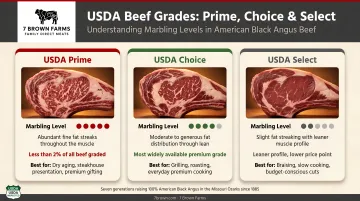
USDA grading gives you a reliable starting point for marbling expectations:
| Grade | Marbling Requirement |
|---|---|
| Prime | Slightly Abundant |
| Choice | Small |
| Select | Slight |
For a cowboy ribeye specifically, Prime is worth the premium. The extra marbling means less moisture lost during cooking and a more forgiving window if your sear runs a little hot. 7 Brown Farms' 100% American Black Angus cowboy ribeyes are 14-day dry-aged minimum and finished on a custom grain diet developed for Missouri Ozarks pasture conditions—which builds the intramuscular fat that makes high-heat cooking far more forgiving than commodity cuts.
How to Cook a Thick-Cut Bone-In Cowboy Ribeye Step by Step
Step 1: Season the Steak
Start by patting the steak completely dry with paper towels. Surface moisture is the enemy of a good sear—water caps the surface temperature at 212°F until fully evaporated, preventing the 280–330°F temperatures required for Maillard browning reactions that create crust and flavor.
Season generously on all sides — roughly ¾ teaspoon of kosher salt per pound — and add cracked black pepper until you have visible, even coverage. The thickness of a cowboy ribeye demands deep seasoning penetration, not a light dusting. For even better crust formation, season the night before and refrigerate uncovered: the surface dries further and the salt penetrates deeper.
Step 2: Sear on the Stovetop
Preheat your cast iron skillet over high heat for 5 minutes until smoking hot. Cast iron's thermal mass is critical here: when a cold steak hits stainless steel, the temperature can crash 150–200°F, while cast iron drops less than 50°F, keeping the pan in the ideal Maillard zone.
Once the pan is smoking:
- Add a high smoke point oil — avocado, canola, or grapeseed
- Sear each flat side 3–5 minutes without moving to build a deep, golden-brown crust
- Briefly hold the steak on its edges and around the bone to sear those surfaces too
These Maillard reactions create flavor compounds that the oven simply cannot replicate.
Step 3: Finish in the Oven
After searing, place the skillet directly into a preheated 375°F oven. Insert a probe thermometer into the thickest part of the steak horizontally, avoiding the bone. The bone's honeycomb structure acts as a thermal insulator, leaving meat immediately adjacent to the bone 5–10°F cooler than the center—so avoid the bone when checking temperature or you'll get a false reading.
Cook until the thermometer reads 5°F below your target doneness:
| Doneness | Final Target Temp | Pull Temperature |
|---|---|---|
| Rare | 120°F | 115°F |
| Medium-Rare | 130°F | 125°F |
| Medium | 140°F | 135°F |
| Medium-Well | 150°F | 145°F |
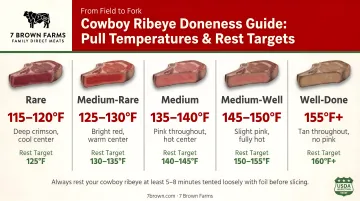
Oven time varies by thickness and starting temperature—typically 8–15 minutes for a 2-inch steak, up to 20 minutes for a 3-inch cut.
Step 4: Rest and Serve
Once removed from the oven, rest the steak loosely tented with foil for a minimum of 10 minutes. During this time, carryover cooking occurs: a 2-inch steak can experience 10–15°F of internal temperature rise as retained heat distributes through the meat.
Resting allows muscle fibers to reabsorb juices that were pushed toward the center during cooking. America's Test Kitchen research confirms this principle holds across proteins: proper resting reduces moisture loss by roughly 60% compared to cutting immediately.
Slice against the grain away from the bone. A pat of compound butter melting into the crust is all a well-marbled ribeye needs.
Key Variables That Determine How Your Cowboy Ribeye Turns Out
A cowboy ribeye is not set-it-and-forget-it. These variables separate restaurant-quality results from expensive mistakes:
Steak thickness and starting temperature: A 2-inch steak and a 3-inch steak behave very differently in the same oven. A steak that hasn't rested at room temperature takes longer to cook and risks a grey ring of overdone meat around an underdone center. This thermal gradient problem happens because the cold core absorbs heat slowly while the exterior continues cooking—and there's no fixing it once it's done.
Pan and oven heat consistency: A skillet that isn't hot enough before adding the steak causes the meat to steam rather than sear, producing a grey exterior instead of a crust. Cast iron requires 3–5 minutes of preheating to reach 400–500°F and distribute heat evenly across the surface. A proper high-heat sear is irreversible once missed—there's no recovering a steamed exterior in the oven.
Marbling quality and dry aging: Fat distribution acts as an internal basting mechanism during cooking. Research shows that steaks with higher marbling scores have lower cooking loss and reduced shear force, meaning they stay juicier and cut more tenderly. Dry-aged beef loses 3–6% moisture over 14 days, which concentrates flavor and lets the surface sear faster—which is why farms like 7 Brown Farms that enforce a 14-day minimum dry-aging process produce steaks that are harder to accidentally overcook and don't need sauce to taste rich.
Resting time: Resting is the final stage of cooking, not an afterthought. Recent testing by Modernist Cuisine shows that juice loss is dictated by internal vapor pressure at the moment of slicing. The hotter the meat, the higher the pressure, which pushes liquid outward when cut. As the meat rests and cools, vapor pressure decreases, reducing juice loss.
Common Mistakes When Cooking a Cowboy Ribeye
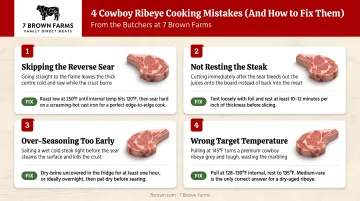
Most cowboy ribeyes get ruined by one of four fixable errors. Avoid these and everything else falls into place:
- No thermometer — Visual cues (color, touch, timing) fail on a 2–3 inch cut. The exterior can look done while the center is still raw. A meat thermometer is the only reliable call.
- Cold steak straight from the fridge — A cold center forces the outside to overcook before the inside reaches temperature. Pull the steak 30–40 minutes before cooking; it's non-negotiable at this thickness.
- Underpowered sear — A medium-hot pan steams instead of sears. Preheat your cast iron on high for a full 5 minutes before the steak goes in. High heat, fast crust, no exceptions.
- Cutting too soon or with the grain — Slicing immediately drains the juices. Cutting parallel to the muscle fibers leaves tough, chewy bites. Rest the steak first, then slice perpendicular to the grain for the most tender result.
Other Ways to Cook a Cowboy Ribeye
While the sear-then-oven method produces reliable results, some setups, preferences, or equipment call for different approaches. Each has trade-offs in time, effort, and final texture.
Reverse Sear
Start in a low oven at 250–275°F until the steak reaches 10°F below target temperature, rest briefly, then sear in a pan heated until it just begins to smoke. This method flattens the thermal gradient — the temperature gap between the outer crust and the center — eliminating the thick band of gray, overcooked meat just inside the crust. The result is extremely even doneness edge-to-edge.
Best for: Cuts thicker than 2.5 inches or dinner parties where precise doneness matters. Budget 45–90 minutes total.
Grill (Direct + Indirect)
Use a two-zone grilling setup: start over indirect heat at 220–225°F, finish with a direct sear over high flame. This method adds smoke flavor and charred exterior but requires managing flare-ups with a fatty cut like cowboy ribeye.
Ideal when: You want outdoor cooking or a smoky char. Internal temperature monitoring is still essential — flare-ups on a fatty cut happen fast.
Sous Vide + Sear
Cook in a precisely controlled water bath at your target temperature (typically 129–134°F for medium-rare ribeye) for 2 hours, then sear briefly in a hot pan. Note that cook time scales with thickness: a 2-inch steak pulled from the fridge needs roughly 3 hours 35 minutes to reach bath temperature. The method eliminates overcooking and delivers edge-to-edge consistency, but requires specialized equipment and demands an aggressive post-sear to build real crust.
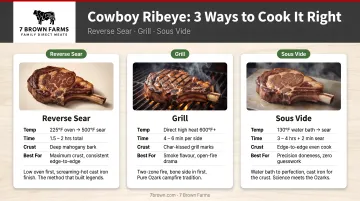
Choose this if: You're cooking multiple steaks at once or need identical doneness across every plate.
Conclusion
A thick-cut bone-in cowboy ribeye rewards patience and precision. The right starting temperature, a smoking-hot sear, a calibrated oven finish, and a proper rest will produce a result that rivals any steakhouse. When cooks fall short, it's almost always the same two culprits: skipping the thermometer or cutting into the steak before it rests.
The cut you start with determines the ceiling of what's possible. A well-marbled, properly aged cowboy ribeye makes every step easier. Farms like 7 Brown Farms raise American Black Angus on Missouri Ozarks pastures, finish on custom grain programs, and dry-age for a minimum of 14 days. That quality coming in is what every technique in this guide is built to bring out.
Frequently Asked Questions
What is a cowboy ribeye and how does it differ from a regular ribeye?
A cowboy ribeye is a bone-in ribeye cut 2–3 inches thick with a portion of the rib bone left exposed and frenched (cleaned of meat and fat). A standard ribeye is typically boneless and 1–1.5 inches thick. The bone contributes flavor and acts as a thermal insulator, while the greater thickness requires different cooking techniques.
Why is a cowboy ribeye so expensive?
The price reflects the cut's size (often 2–3 lbs of premium beef), the labor involved in bone-in processing, and the higher marbling grades typically required. For single-estate, hormone-free beef like 7 Brown Farms' American Black Angus, the cost of raising quality animals on sustainable pastures adds to that premium.
Is a cowboy ribeye bad for cholesterol or other nutrients like potassium?
A cowboy ribeye is high in saturated fat and dietary cholesterol, but also delivers significant protein, zinc, iron, and potassium (233 mg per 100g). Research on grain-finished beef shows that quality grain programs can produce a more favorable Omega-6 to Omega-3 ratio (averaging 7.65:1 vs. 13.5:1 in some conventional beef).
What temperature should a cowboy ribeye be cooked to?
The USDA recommends a safe minimum of 145°F for medium, but most steak enthusiasts prefer medium-rare at a final resting temperature of 130–135°F. Pull the steak 5°F below your target since carryover cooking continues during the rest period.
How long should you rest a cowboy ribeye before cutting?
A thick-cut cowboy ribeye should rest a minimum of 10 minutes, loosely tented with foil, to allow the internal vapor pressure to decrease. Cutting sooner causes significant moisture loss to the plate rather than keeping it in the steak.
Should I cook a cowboy ribeye from frozen or fully thawed?
Always cook fully thawed — refrigerator thaw for at least 24 hours. Cooking from frozen causes the exterior to overcook before the center reaches a safe temperature, and intentional "frozen sear" techniques are designed for thin cuts, not a 2–3 inch bone-in steak.