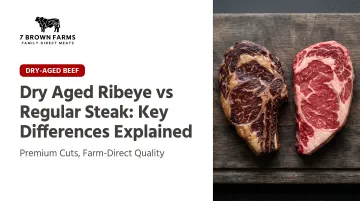
As "dry-aged" appears more frequently on restaurant menus and specialty meat labels, consumers and chefs rarely understand what they're actually paying for. Many struggle with questions like: Why does one steak cost twice as much? What changes during aging? Is the premium worth it?
This guide breaks down the real differences between dry-aged and regular ribeye—the science behind aging, side-by-side comparison across key attributes, and guidance on when each type makes the most sense for your table.
Key Takeaways
- Dry-aged ribeye spends 14–45+ days in controlled environments, concentrating flavor and tenderizing through natural enzymes
- Regular ribeye goes straight from processing to sale with minimal aging — fresher, but milder in flavor and typically less tender
- Dry-aged ribeye delivers deeper, nuttier complexity; regular ribeye offers a cleaner, familiar beef taste
- Dry-aged costs more due to 15–30% moisture shrinkage, extended storage time, and specialized equipment
- Your choice comes down to palate, occasion, and budget — this guide breaks down exactly what sets them apart
Dry Aged Ribeye vs Regular Steak: Quick Comparison
| Attribute | Dry-Aged Ribeye | Regular (Fresh) Ribeye |
|---|---|---|
| Aging Process | 14-90+ days in controlled temperature, humidity, and airflow | Minimal or no aging; vacuum-sealed wet-aging for days to weeks |
| Flavor Profile | Concentrated, nutty, earthy, umami-forward with buttery notes | Clean, recognizable beef flavor; mild and straightforward |
| Texture | Fork-tender, velvety bite from enzymatic breakdown | Varies by grade; tender when cooked properly but lacks pre-tenderization |
| Moisture Content | 10-20% moisture loss; denser, more concentrated | Full moisture retention; juicier immediately after cooking |
| Price Point | $40-$55+ per pound due to shrinkage and time | $14-$22 per pound depending on grade |
| Best Use | Special occasions, steakhouse menus, serious home cooks, gifting | Everyday grilling, weeknight meals, casual cooking, meal prep |
These differences stem from deliberate biochemical processes, driven by how aging reshapes the meat's structure, flavor compounds, and final texture.
Note: "Regular steak" here means a non-aged or minimally aged fresh-cut ribeye — not a lower-quality grade. A USDA Prime fresh ribeye is still an excellent steak.
What Is a Dry-Aged Ribeye?
Dry aging is a controlled process where large ribeye primals or bone-in cuts are stored uncovered in temperature-, humidity-, and airflow-managed environments for 14 to 90+ days. The open-air exposure is essential—unlike wet aging, which seals moisture in vacuum bags, dry aging allows deliberate evaporation and enzyme activity.
Two key biochemical changes occur during dry aging:
- Moisture evaporation concentrates the beef's natural flavors into a smaller, denser cut
- Naturally occurring enzymes (calpains and cathepsins) break down muscle fiber proteins, producing fork-tender texture that fresh cuts cannot replicate
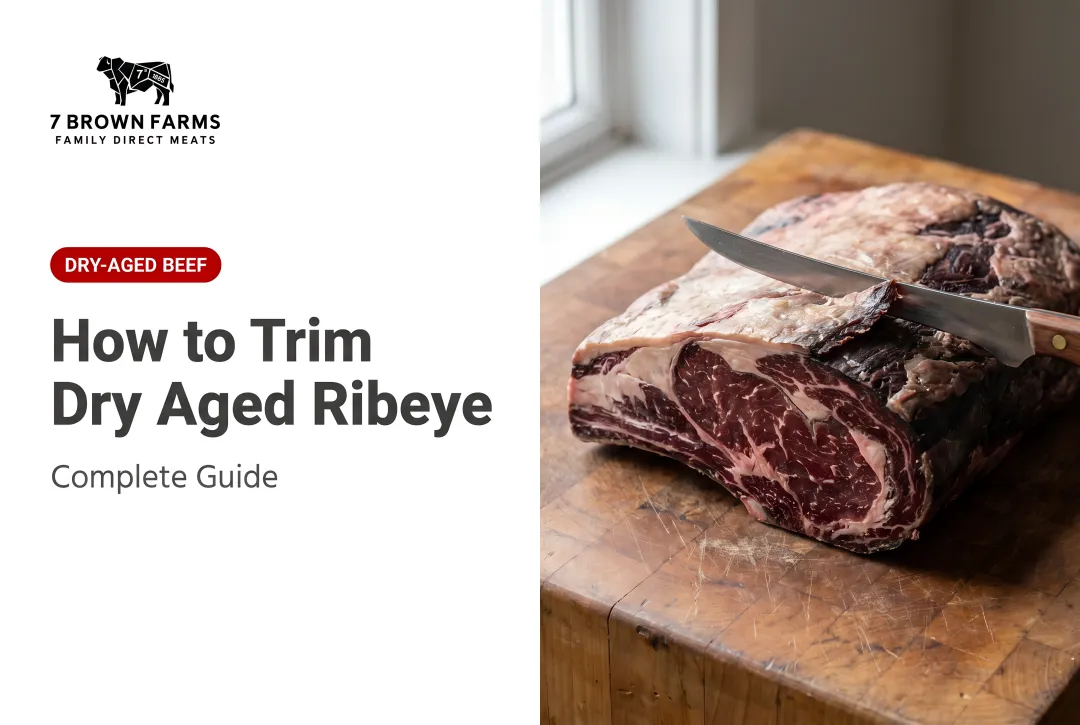
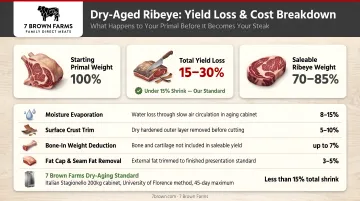
During aging, a hard, dark outer crust called the "pellicle" forms on exposed surfaces. This inedible layer must be trimmed before the steak is sold or cooked. This trimming contributes to weight loss—typically 15-24% of the original primal—and is a primary reason dry-aged beef costs more per pound.
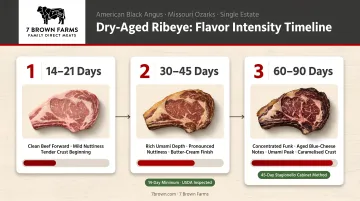
Aging duration determines flavor intensity:
- 14-21 days: Milder, slightly nutty notes with improved tenderness
- 30-45 days: Earthy, buttery complexity with pronounced umami
- 60-90+ days: Pungent, blue cheese-like depth that divides opinions
The ribeye cut is particularly well-suited to dry aging because its abundant intramuscular fat (marbling) acts as a protective barrier. As surface moisture evaporates, the marbling sustains internal juiciness while controlled lipid oxidation generates the nutty and buttery flavors characteristic of dry-aged beef. Leaner cuts lack this fat shield and suffer excessive dehydration.
7 Brown Farms' 45-day dry aging program uses Italian Stagionello 200 kg cabinets following University of Florence protocols. The result: less than 15% shrink loss on primals, compared to an industry standard of 20-50%. For buyers ordering bulk primals or premium cuts direct from the farm, that tighter shrink loss translates directly into more usable beef per pound paid.
Use Cases of a Dry-Aged Ribeye
Dry-aged ribeye shines in specific scenarios:
- Special occasion dinners where flavor complexity justifies the premium
- Steakhouse menus seeking to differentiate with restaurant-quality offerings
- Serious home cooks wanting to replicate fine dining experiences
- Gift buyers looking for premium cuts that make an impression
In each case, the decision comes down to one question: do you want a steak that tastes like beef, or one that tastes like the best beef you've ever had? Dry aging answers that clearly.
What Is a Regular (Fresh) Ribeye?
A regular ribeye is cut from the rib primal and sold fresh or after minimal wet-aging (vacuum-sealed in its own juices for days to a few weeks). It retains full moisture content and delivers the familiar, clean beef flavor most consumers recognize from everyday cooking.
Benefits of a fresh ribeye:
- Full weight yield with no shrink loss
- More affordable price point ($14–$22 per pound for Choice grade)
- Widely available at supermarkets and butcher shops
- Versatile for everyday grilling, stir-fry, or meal prep
- Natural marbling delivers solid juiciness and flavor straight off the grill
Quality shifts sharply by USDA grade and cattle breed. A well-marbled, grain-finished Black Angus Choice ribeye will outperform a commodity Select cut even without aging — and the grading system explains why: USDA Prime requires "slightly abundant" marbling, Choice requires "small" marbling, and Select requires only "slight" marbling. Those differences directly impact juiciness and flavor intensity.
Flavor, Texture, and Price: How They Really Compare
Flavor
Dry-aged ribeye develops concentrated, complex notes through proteolysis and lipid oxidation. What starts as standard beefy taste evolves into layers of nuttiness, earthiness, and buttery umami-forward depth. Free amino acids increase 25-40% during aging, with glutamate (responsible for umami) rising 30-45% over 21 days. These flavors are most pronounced around the bone and in the fat, where volatile aldehydes and ketones concentrate during the Maillard reaction when searing.
Regular ribeye offers clean, recognizable beef flavor—milder and more straightforward. The taste experience is tied directly to marbling quality and cooking method rather than aging complexity. There's no funky edge, no earthy undertones—just pure, familiar beef.
Texture
Dry-aged ribeye achieves a distinctly tender, almost velvety bite through enzymatic breakdown. Calpains and cathepsins cleave structural proteins like titin, nebulin, and desmin, loosening the myofibril lattice. The texture is described as "tighter" than fresh but effortless to chew—a melt-in-mouth quality that comes from pre-tenderized muscle fibers.
Maximum tenderness is achieved by days 28-35; further aging yields minimal texture improvements. Beyond that window, time in the aging cabinet builds flavor—not tenderness.
Regular ribeye texture varies by grade and cut thickness. It can be tender with proper cooking—reverse sear, adequate rest time—but there's no enzymatic head start. Marbling quality plays a larger role in a fresh cut's tenderness than any other single factor.
Price and Value
Dry-aged ribeye costs more due to three compounding factors:
- Evaporation shrinks sellable weight by 10-20% before the first cut
- Pellicle trimming removes another 15-24% of the original primal
- Weeks of refrigeration and specialized aging equipment add fixed overhead to every pound sold
Total saleable yield drops from ~88% (wet-aged baseline) to approximately 63.5% after 35 days. This physical loss of product mathematically requires a massive retail markup.
Current market pricing (2025 data):
- Fresh USDA Choice ribeye: $14.30-$18.39 per pound at major supermarkets
- Dry-aged USDA Prime ribeye: $40-$55+ per pound at specialty retailers
Regular ribeye pricing is driven by grade, breed, and region—no aging overhead. A well-marbled Choice ribeye at $16 per pound represents excellent value for everyday meals.
Dry-aged ribeye isn't overpriced—it's an entirely different product requiring more time, skill, and controlled infrastructure. The premium makes sense when flavor complexity is the goal. For casual grilling or weeknight dinners, a fresh ribeye at $16 a pound still outperforms most proteins on the table.
Which Should You Choose?
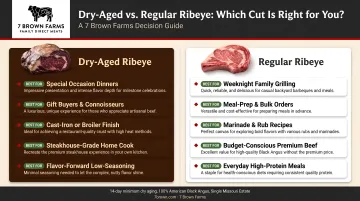
Choose dry-aged ribeye when:
- Flavor complexity and tenderness are your top priorities
- You're celebrating a special occasion or date night
- You want a steakhouse-quality home cooking experience
- You're gifting a serious meat lover who appreciates premium cuts
Choose regular ribeye when:
- Budget matters or you're cooking for everyday meals
- You prefer a clean, familiar beef flavor without funk
- You're grilling casually or preparing weeknight dinners
- You need versatile cuts for stir-fry or meal prep
One factor shapes the outcome regardless of which path you take: starting quality. Whether dry-aged or fresh, single-origin, pasture-raised beef outperforms commodity cuts at every price point. The aging process amplifies what's already there — a high-quality base animal produces a dramatically better dry-aged result.
7 Brown Farms raises 100% American Black Angus on a single Missouri Ozarks estate, with all cuts USDA inspected and dry-aged a minimum of 14 days. Extended 45-day aging is available for custom and bulk orders, and two-day shipping covers the contiguous US. Call Farmer Brown directly at 314-540-5515 for custom cuts or bulk pricing.
Frequently Asked Questions
Is a dry-aged ribeye better than a regular ribeye?
It depends on what you're optimizing for. Dry-aged offers superior flavor complexity and guaranteed tenderness, while a regular ribeye provides familiar taste and better value for everyday use. For special occasions, dry-aged wins—for weeknight meals, fresh ribeye is the smarter choice.
Is dry-aged beef better than prime beef?
These aren't either/or categories. "Prime" refers to USDA grading (marbling level assigned at the carcass), while "dry-aged" refers to a post-harvest process. The best outcome is Prime-graded beef that is also dry-aged, combining superior marbling with concentrated flavor.
Is aged steak high in histamine?
Dry aging involves microbial activity that can increase histamine levels compared to fresh cuts. However, properly controlled aging environments maintain histamine below 12 mg/kg—well below the 50-100 mg/kg toxicological concern threshold. People with histamine sensitivities should be aware of this difference.
How long should a ribeye be dry-aged for the best flavor?
Most palates land in the 28-45 day sweet spot—complex but not overwhelming. New to dry-aged? Start at 14-21 days; push to 45-90 only if you want maximum depth and can handle polarizing blue cheese-like intensity.
Why is dry-aged ribeye more expensive than regular steak?
Moisture loss (10-20%), weeks of refrigerated storage, and pellicle trimming (15-24% waste) all cut into yield. Sellable meat drops to roughly 63.5% of the original primal, which drives the higher cost per pound.
Can I dry-age a ribeye at home?
Technically yes, but you need a dedicated mini-fridge with precise humidity (75-85% RH) and airflow control. Without it, you risk spoilage rather than proper aging. Professional-grade cabinets—like the Italian Stagionello systems used by specialty farms—deliver far more consistent, safe results than DIY setups.