This guide covers everything you need before cooking, a precise stovetop method, the variables that determine juiciness and crust, common mistakes, and how to troubleshoot when things go wrong.
Key Takeaways
- Stovetop pan-searing creates a Maillard-reaction crust while keeping the interior tender through high, direct heat
- Use a well-marbled ribeye (1 to 1.5 inches thick), cast iron skillet, and high smoke-point oil like avocado or canola
- Pat the steak completely dry, season generously, and wait until the pan is shimmering-hot before adding the steak
- Butter-baste with garlic and herbs in the final minutes for the rich, steakhouse-quality finish home cooks often miss
- Rest the steak 5–10 minutes before slicing to retain juices
What You Need Before Cooking Ribeye on the Stove
Preparation quality determines your final result. Steak selection, pan choice, and setup all matter as much as technique.
Choosing the Right Ribeye
Look for these non-negotiables:
- Visible marbling: Thin white fat streaks throughout the meat, not just around the edge
- Thickness: 1 to 1.5 inches minimum—thinner steaks overcook before they can develop a crust
- USDA grading: Prime or Choice grade ensures sufficient intramuscular fat
Marbling melts during cooking, basting the meat from the inside and creating ribeye's signature juiciness. If you want to take sourcing off the table entirely, 7 Brown Farms raises 100% American Black Angus on a single Missouri estate, USDA-inspected and 14-day dry-aged, so the marbling is already there when it arrives.
Bone-in vs. boneless trade-off:
- Bone-in: Adds flavor near the bone but cooks unevenly due to bone insulation; meat near the bone stays about 10°F cooler
- Boneless: Easier to manage for stovetop searing; uniform contact with the pan creates consistent crust
Once you've settled on the cut, the right equipment and prep sequence make everything else easier.
Equipment and Prep
Essential equipment:
- Cast iron skillet (preferred for heat retention and sear quality) or heavy-bottomed stainless steel pan
- Metal tongs
- Instant-read meat thermometer
- High smoke-point oil: avocado (480°F–520°F), canola (400°F–475°F), or vegetable oil—not olive oil
- Unsalted butter, garlic cloves, fresh thyme or rosemary for basting
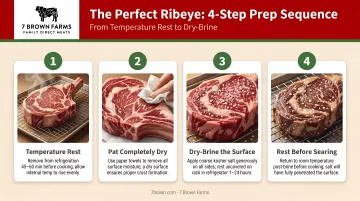
Prep sequence:
- Temperature rest: Remove steak from fridge 20–30 minutes before cooking if targeting medium or above; for rare, cook cold to keep the interior from overcooking
- Pat dry: Completely dry both sides with paper towels—surface moisture prevents browning
- Season aggressively: Apply coarse salt and freshly cracked pepper to both sides and edges; press it in rather than rubbing hard
- Optional dry-brine: Season and leave uncovered in the fridge for 1–3 hours (or overnight) for deeper flavor and a drier surface
How to Cook Ribeye Steak on the Stove, Step by Step
Total active cooking time: 10–15 minutes for a 1 to 1.5-inch ribeye targeting medium-rare.
Step 1: Preheat the Pan
Place your cast iron or heavy stainless skillet over high heat and preheat for 3–5 minutes. Most people pull the pan too early — wait until a drop of water evaporates on contact or a thin film of oil shimmers and shows faint wisps of smoke.
Add a thin layer of high smoke-point oil and swirl to coat. The oil should move fluidly and shimmer immediately. Skipping this step is the most common cause of poor sear quality.
Step 2: Sear the First Side
- Place the steak away from your body to prevent oil splatter
- Leave it completely undisturbed for 2–3 minutes
- Resist the urge to move or press the steak — the Maillard reaction requires 285°F–330°F surface temperature and uninterrupted contact
The steak will naturally release when the crust has formed. If it sticks, it's not ready to flip.
Optional technique: After 1.5–2 minutes, gently move the steak in a slow circular motion for 30–60 seconds to pick up fond (browned bits) and maximize crust coverage.
Step 3: Flip, Baste, and Finish
Flip the steak once. Immediately reduce heat to medium-low and add:
- 2–3 tablespoons unsalted butter
- Smashed garlic cloves
- Fresh thyme or rosemary
Once the butter melts and begins foaming, tilt the pan so butter pools on one side. Continuously spoon it over the top of the steak for 1.5–2 minutes — this butter-basting technique creates restaurant-quality richness and noticeably reduces overall cooking time.
Finish the edges: Use tongs to briefly hold the steak upright and sear the fat-cap edge for 30–45 seconds.
Check doneness with an instant-read thermometer:
| Doneness | Target Temperature |
|---|---|
| Rare | 120–125°F |
| Medium-Rare | 130–135°F |
| Medium | 140–145°F |
| Medium-Well | 150–155°F |
| Well-Done | 160°F+ |
Pull the steak from heat when it reads 5°F below target — carry-over cooking will finish the job during rest.
Step 4: Rest and Slice
Transfer the steak to a wire rack or cutting board and loosely tent with foil. Rest for at least 5 minutes, or up to 10 for thicker cuts.
Muscle fibers relax and reabsorb their juices during this window — cut too early and you'll lose that moisture to the cutting board.
Slice perpendicular to the visible muscle fibers (against the grain) for maximum tenderness. Serve immediately, optionally finished with a drizzle of pan butter or a pinch of finishing salt.
Key Variables That Affect How Your Ribeye Turns Out
Even with correct steps, outcomes vary based on four controllable variables. Knowing what each one does lets you course-correct before you ruin a good cut.
Pan temperature
This determines whether the Maillard reaction — browning equals flavor — happens fast enough before the interior overcooks.
Impact:
- Too low = steamed steak with no crust
- Too high = burned crust, raw interior
Cast iron's thermal mass prevents drastic temperature drops when cold meat is added, maintaining the 450–500°F zone required for effective searing. Electric stovetops may require longer preheating than gas.
Steak thickness
Thickness determines how long the interior needs to reach target temperature — and how fast the surface browns relative to that.
Impact:
- Too thin (under 1 inch) = overcooked interior before crust forms
- Over 2 inches = uneven cook without oven assist
Steaks over 1.5 inches may require a brief oven finish after searing to reach target internal temperature without burning the crust.
Internal temperature target
A thermometer is the only variable that removes guesswork regardless of pan, stove type, or thickness.
Impact:
- Relying on time alone leads to overcooked or undercooked results — every stove and pan runs differently
- Always pull 5°F early to account for carry-over cooking
Resting time
Heat causes muscle fibers to contract and push moisture toward the center. Resting allows those fibers to relax and redistribute juice evenly — skip it and you're cutting into a pressurized sponge.
Impact:
- Skipping rest = puddle of juice on the plate and dry steak
- Proper rest = full, juicy bite throughout
Common Mistakes When Cooking Ribeye on the Stove
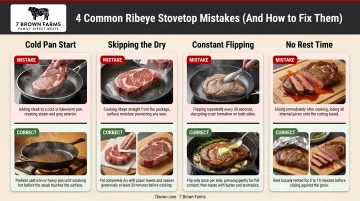
Most stovetop ribeye failures trace back to preparation and heat management. Here are the four mistakes most home cooks make, and what to do instead:
Skipping the pat-dry step — Surface moisture turns into steam when it hits the pan. Water's temperature cap is 212°F, too low for Maillard browning, which requires 285°F+. This creates a gray, rubbery exterior instead of a crust. Pat the steak dry with paper towels before seasoning — don't skip it.
Starting with an under-heated pan — If the steak doesn't sizzle loudly the moment it touches the pan, the pan isn't hot enough. The result: a steak that slowly grays instead of quickly sears. By the time the surface finally browns, the interior is overcooked.
Flipping too early or too often — The crust needs uninterrupted contact with the pan to form properly. Flip before the steak naturally releases, or flip repeatedly, and you'll prevent crust development on both sides.
Cutting before the steak rests — Even a 5-minute rest improves juiciness. Cutting immediately after cooking is the fastest way to lose the juices that make a ribeye worth eating.
Troubleshooting Problems When Cooking Ribeye on the Stove
Most issues have a clear cause and an in-session fix.
Problem: Steak looks gray and steamed, no crust forming
The pan wasn't hot enough before the steak went in, or two steaks crowded together dropped the surface temperature. Next time, wait until the pan is visibly smoking or shimmering. If cooking two steaks, use a larger pan or cook them one at a time.
Problem: Outside is charred but interior is still raw or cool
The heat is too high for the steak's thickness. Cuts over 1.5 inches need a different approach than a straight stovetop sear. Two options work well:
- Sear then finish in the oven: After searing both sides, transfer to a 400–450°F oven for 3–6 minutes until the internal temperature hits your target
- Reverse sear: Bring the steak to temperature in a low oven first, then sear at the end for the crust
Problem: Steak is tough or chewy despite correct internal temperature
The steak was likely sliced with the grain rather than against it, or the cut had less marbling than needed to stay tender past medium. Always identify the direction of muscle fibers and slice perpendicular to them. For future cooks, prioritize well-marbled ribeye (USDA Prime or equivalent)—leaner cuts toughen more when cooked past medium.
Frequently Asked Questions
Is ribeye good for cholesterol?
Ribeye is higher in saturated fat, which raises LDL cholesterol levels, so eat it in moderation. It also contains heart-supportive nutrients like zinc and B vitamins. Grass-fed beef generally has a more favorable omega-6 to omega-3 ratio than conventional feedlot beef. Keeping portions to 6–8 oz and pairing with vegetables makes ribeye a reasonable fit in most diets.
Is ribeye steak good for meal prep?
Ribeye is best eaten fresh, but leftovers keep well in an airtight container for 3–4 days. For meal prep, slice cold leftover ribeye over salads, grain bowls, or wraps — this preserves texture far better than reheating.
How long will ribeyes last in the fridge?
Raw ribeye steaks keep well in the refrigerator for 3–5 days if properly wrapped, or in the freezer for up to 6–12 months. Cooked ribeye leftovers should be consumed within 3–4 days stored in an airtight container.
What is the best pan for cooking ribeye on the stove?
A well-seasoned cast iron skillet is the top choice for excellent heat retention and sear quality; heavy-bottomed stainless steel is a solid backup. Avoid nonstick pans — they can't handle the high heat needed for a proper crust.
Should I cook ribeye from room temperature or cold?
For medium or above doneness, resting the steak at room temperature for 20–30 minutes helps it cook more evenly. For rare or medium-rare, cooking cold from the refrigerator actually helps maintain a pink, warm interior by slowing internal temperature rise while the exterior sears.
What internal temperature is medium-rare ribeye?
Medium-rare is reached at 130–135°F internal temperature. Pull the steak from the pan at 125–130°F and let carry-over cooking during the rest period bring it to final temperature. Always use an instant-read thermometer for reliable results.