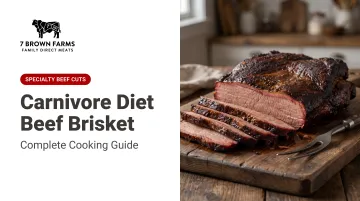
This guide covers why brisket works perfectly for carnivore eating, how to choose the right cut, carnivore-specific prep (spoiler: it's just salt), three cooking methods with exact temps and timing, and how to slice and store leftovers for a week of zero-carb meals.
TLDR: Carnivore Brisket at a Glance
- Brisket is 100% carnivore-compliant with zero carbohydrates—salt is the only seasoning required
- Point cut offers higher fat content (13.8g per 100g); flat cut is leaner with uniform slicing
- Cook at at 225–275°F until internal temp reaches 195–205°F
- Rest for 30 minutes minimum before slicing perpendicular to the grain
- Single-estate, dry-aged brisket from hormone-free, antibiotic-free cattle produces the best cut—marbling and sourcing directly affect flavor and nutrient density
Why Brisket Is the Ultimate Carnivore Diet Cut
Brisket comes from the breast and lower chest of the animal, drawn from the superficial and deep pectoral muscles. These muscles support most of the steer's body weight throughout its life, resulting in heavily exercised tissue packed with connective tissue, collagen, and intramuscular fat. That dense structure is exactly what makes brisket ideal for carnivore eating.
Nutritional Profile for Carnivore Dieters:
USDA FoodData Central shows significant variation between cuts, but all deliver zero carbohydrates:
| Cut (Cooked, Braised) | Serving | Calories | Protein | Fat | Carbs |
|---|---|---|---|---|---|
| Point Half (trimmed to 0" fat) | 100g | 244 kcal | 28.0g | 13.8g | 0g |
| Flat Half (trimmed to 1/8" fat) | 100g | 280 kcal | 28.9g | 17.4g | 0g |
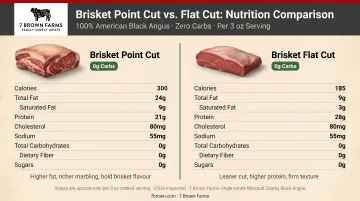
The point cut provides a higher fat-to-protein ratio inherently suited to carnivore macros, while the flat delivers leaner, protein-dense nutrition with consistent slicing characteristics.
The Science of Low and Slow:
Brisket's dense connective tissue consists primarily of collagen, which requires sustained heat between 160°F and 200°F over many hours to fully hydrolyze into gelatin. This conversion is what creates the signature "melt-in-your-mouth" texture carnivore dieters prize. Cooking above 275°F seizes muscle fibers before collagen melts, producing tough, chewy meat. Low and slow isn't optional. It's the method.
The fat cap matters too. Unlike leaner cuts, brisket's fat cap renders during cooking and continuously bastes the meat from the outside in. Don't trim it aggressively:
- Rendered fat is a primary source of satiety on a carnivore diet
- It carries most of the flavor developed during the long cook
- It contributes zero carbohydrates while supporting the high-fat macro target
Choosing the Right Brisket for Carnivore Cooking
Flat Cut vs. Point Cut
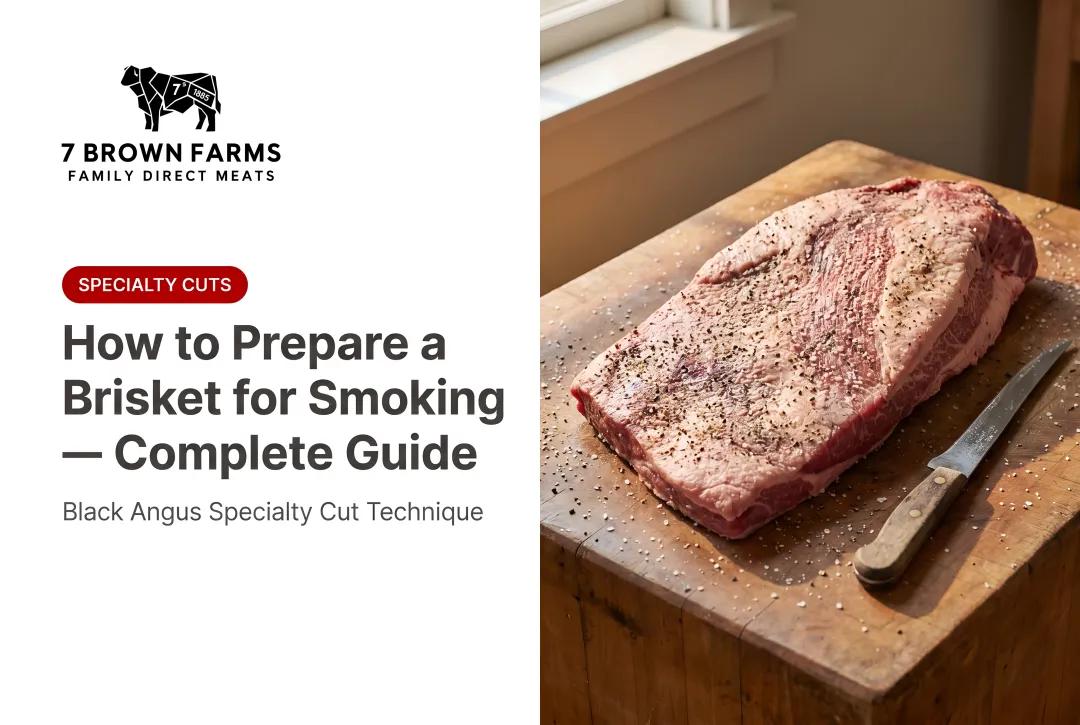
A whole "packer" brisket (IMPS 120) includes both muscles separated by a seam of fat:
- Flat cut (120A): The deep pectoral muscle—leaner, rectangular, uniform thickness with less intramuscular fat. Slices cleanly and consistently, making it ideal for meal prep and portioning
- Point cut (120B): The superficial pectoral muscle—thicker, highly marbled with significant intramuscular fat. More flavorful, more forgiving during long cooks, and preferred by carnivore dieters prioritizing fat intake
What to Look For:
- Marbling: Good marbling throughout the flat; abundant marbling in the point
- Fat cap: At least ¼ inch thick (protects meat and provides basting fats)
- Color: Deep red indicating freshness and proper aging
- Grade: USDA Prime features "slightly abundant" to "abundant" marbling, providing maximum forgiveness during extended cooking. Choice offers "moderate" marbling but requires more careful temperature management
Sourcing Quality:
Brisket from cattle raised without hormones, antibiotics, or feed additives produces cleaner flavor and better nutritional quality. 7 Brown Farms raises 100% American Black Angus on a single Missouri estate in the Ozarks, finished on custom grain programs optimized for omega-6/omega-3 balance. Their whole packer briskets (7-10 lbs) ship frozen direct to consumers, 14-day dry-aged with no hormones or antibiotics—raised by the same family since 1885.
Sizing Guidance:
- 5-7 lb brisket: Feeds a family; scales at roughly 1 hour per pound at 250°F
- Larger packers (10-15 lbs): Better value per pound; exceptional for meal prep as leftovers reheat perfectly for carnivore batch cooking
Buy the largest brisket that fits your cooking vessel—you'll thank yourself when you have five days of zero-carb meals ready to go.
How to Prep Brisket the Carnivore Way
Salt Is Your Only Seasoning
Use coarse kosher salt generously on all sides — this is your entire rub. Salt does two things: it seasons deeply, and it draws out surface moisture that gets reabsorbed back into the meat, carrying the salt with it. This process — called dry brining — increases the meat's water-holding capacity, so you lose less moisture during the long cook and end up with noticeably juicier slices.
Overnight Salting (Dry Brine):
- Season the brisket generously the night before
- Place fat-side up in a roasting pan or on a rack
- Refrigerate uncovered for 12-24 hours — larger cuts benefit most from the full 24 hours
The extended rest lets the salt work all the way into the muscle fibers, not just the surface. The result: the meat holds onto more of its natural juices through hours of cooking heat.
Tempering and Fat-Side Position
Pull the brisket from the fridge 45-60 minutes before cooking. Cold meat placed directly into a hot oven cooks unevenly — the outer layers overshoot their target temperature before the center catches up. A brief rest at room temperature evens out the heat distribution from edge to center.
Fat-side placement depends on your cooking method:
- Oven cooking: Fat-side up allows the rendering fat to continuously baste the meat as it cooks
- Smoking: Fat-side down shields the meat from direct radiant heat off the coals or flame
Carnivore Brisket Cooking Methods: Oven, Smoker, and Slow Cooker
Oven Method (Best for Beginners)
Instructions:
- Preheat oven to 250°F
- Place salted, tempered brisket fat-side up in a foil roasting pan
- Cover tightly with foil to trap moisture
- Place a dish of water on the rack below the brisket to maintain moisture in the oven environment
- Cook for approximately 1 hour per pound—do NOT open the foil during cooking
- Brisket is done when internal temperature reaches 195-205°F and a probe slides in with no resistance
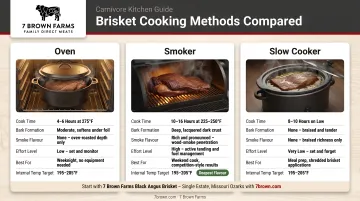
Total Time Estimate: 6-10 hours depending on size
If you're comfortable with set-it-and-forget-it cooking, the oven method is a reliable starting point. Once you're ready for more flavor complexity, the smoker delivers results no oven can match.
Smoker Method (Best for Maximum Flavor)
Instructions:
- Set smoker to 225°F with brisket fat-side down (fat protects from direct heat)
- Add a water pan inside the smoker to maintain humidity
- After 2 hours, flip the brisket and insert a probe thermometer into the thickest part
- Spray the brisket with water every 1-2 hours to maintain surface moisture
- At 165°F internal temp, wrap in butcher paper (not foil—foil softens the bark and steams the exterior)
- Pull at 203-208°F when a probe slides through like butter
Between 150-170°F, expect the internal temperature to plateau for several hours. This is evaporative cooling from the meat's surface — normal, not a problem. Wrapping in butcher paper at 165°F stops that evaporation and accelerates the cook without sacrificing bark texture.
Properly cooked smoked brisket passes the "bend test," drape a slice over your finger and it should hang and bend, not snap.
Total Time Estimate: 10-14 hours
For days when a 12-hour smoke isn't practical, the slow cooker gives you tender, pull-apart brisket with minimal hands-on time.
Slow Cooker Method (Best for Convenience)
Instructions:
- Place salted brisket in slow cooker fat-side up
- Add ½ cup beef broth or water to the bottom to prevent scorching
- Cook on LOW for 8-10 hours — do NOT use HIGH setting (faster cooking produces tougher brisket)
- Internal temp target remains 195-205°F
The slow cooker will not produce a bark. For a caramelized exterior, transfer the finished brisket to a baking sheet and broil for 3-5 minutes.
Total Time Estimate: 8-10 hours
Resting, Slicing, and Storing Your Carnivore Brisket
How Resting Protects Moisture and Texture
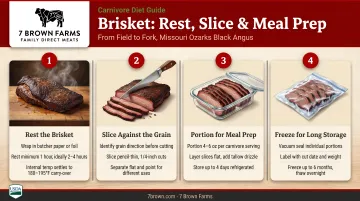
When brisket comes off heat, muscle fibers are contracted and juices are concentrated near the surface. Resting for a minimum of 30 minutes (ideally 1-2 hours) allows fibers to relax and reabsorb juices, keeping each slice noticeably juicier and more tender.
Best Resting Method:
Wrap loosely in foil or butcher paper and place inside a cooler (no ice)—it will hold heat and continue resting safely for up to 2 hours. This "faux Cambro" technique finishes the collagen-to-gelatin conversion while the meat slowly cools to a sliceable temperature.
Slicing Against the Grain
Identify the direction of muscle fibers (they run lengthwise through the flat). Always slice perpendicular to those fibers. Cutting with the grain produces long, chewy strings; cutting against it shortens fibers into bite-sized pieces that pull apart easily.
Technique:
- Use a long, sharp carving knife
- Aim for ¼-inch slices
- The flat and point have fibers running in different directions—rotate the brisket as needed
Storage for Carnivore Meal Prep
Refrigeration:
- Store sliced brisket with its rendered juices in an airtight container
- Safe for 3-4 days at 40°F or below
Freezing:
- Freeze slices with juice for up to 3 months
- Maintain best quality if consumed within this window
Reheating:
Reheat gently in a covered pan with a splash of water or reserved juices on low heat. The fat and gelatin re-emulsify as it warms, preventing dryness—which makes brisket one of the better cuts to batch-cook and reheat throughout the week.
Frequently Asked Questions
Can you eat brisket on the carnivore diet?
Yes, brisket is 100% carnivore-compliant—it's pure beef with zero carbohydrates. The only modification needed is skipping sugar-based rubs and BBQ sauces and seasoning with salt only, making it one of the most satisfying and cost-effective carnivore meals available.
What is the best beef for a carnivore diet?
Well-marbled beef from cattle raised without hormones or antibiotics is ideal. It delivers better fat-to-protein ratios and a nutrient profile free of synthetic additives. Cuts high in fat like brisket, ribeye, and short ribs are especially well-suited to the carnivore diet's energy requirements.
How long does it take to lose 20 lbs on the carnivore diet?
Weight loss timelines vary by individual based on starting weight, metabolic health, activity level, and adherence. Many carnivore practitioners report losing 1-2 lbs per week initially, suggesting 10-20 weeks for a 20-lb loss.
Does the carnivore diet affect cholesterol levels?
Research findings are mixed. A 2026 scoping review of nine human studies noted participants frequently experience elevated LDL and total cholesterol levels, though some report improved HDL and triglyceride ratios. Consult a healthcare provider and monitor lipid panels regularly.
Is the carnivore diet good for arthritis?
Some carnivore followers report reduced joint inflammation after eliminating plant-based compounds and processed foods. Limited case series data show reductions in inflammatory markers, but controlled clinical trials are lacking. Speak with your doctor before using diet as a therapeutic intervention.