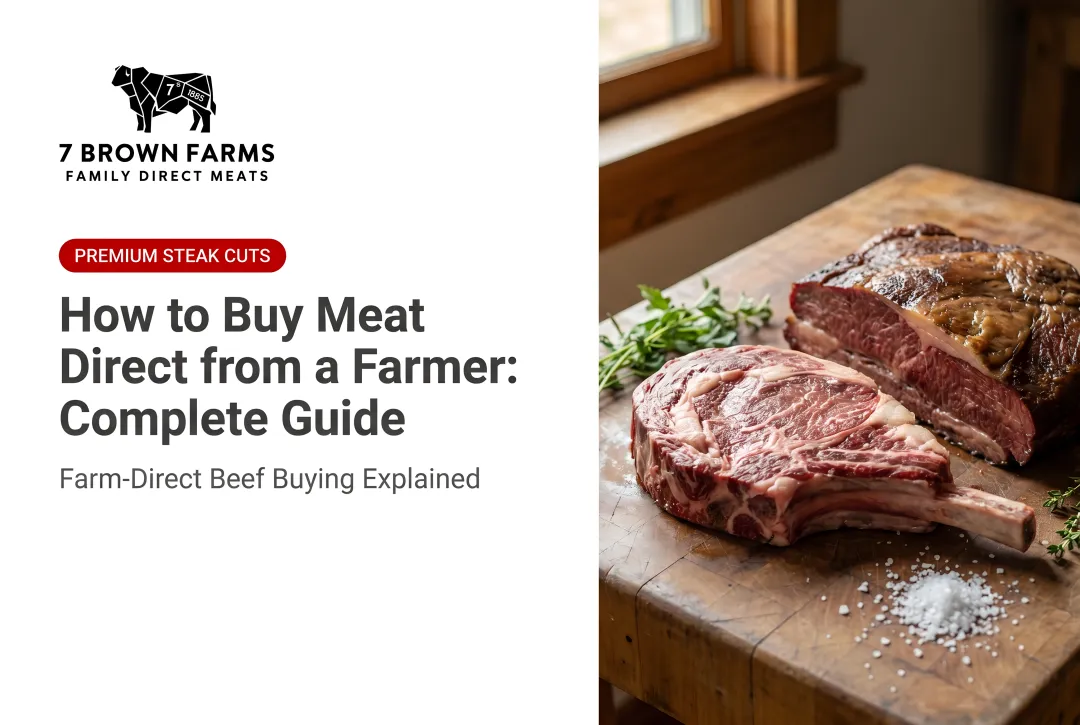
Buying direct is often talked about as a feel-good choice, but its real value shows up in measurable ways: what's in the meat, what's not in it, and how far your dollar actually goes. This article makes the case for why buying directly from your farmer isn't just a lifestyle preference—it's a smarter, healthier, and more honest way to feed your family.
Key Takeaways
- Buying direct eliminates the middlemen who obscure where your food comes from and how it was raised
- Farm-direct beef is fresher, more nutrient-dense, and raised without the hormones, antibiotics, or additives common in industrial supply chains
- Grocery store labeling loopholes (like "Product of USA") can mask foreign-raised or commodity-blended meat
- Bulk or custom cut sheet orders often deliver more value per pound than grocery store pricing at equivalent quality
- Every dollar spent with a family farm goes back to the people — and the land — that raised your food
What "Buying Direct from Your Farmer" Actually Means
Buying direct means purchasing food straight from the farm that raised it, with no distributor, broker, or retail middleman in between. Your money goes to the farmer, and the food comes straight to you. It's not just a local activity anymore—direct purchasing happens through farm websites, CSA shares, farmers markets, bulk or custom orders, and even direct shipping nationwide.
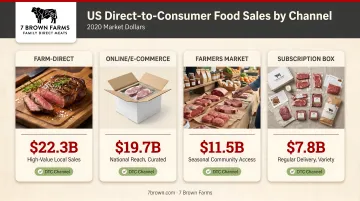
In 2020, U.S. farms sold almost $10.7 billion of edible food commodities directly to consumer outlets, a 35% increase from 2019. Of that total, $2.9 billion came from strictly direct-to-consumer sales, with 77% of farms with direct sales selling directly to consumers. Primary channels included:
- On-farm stores: $1.23 billion
- Farmers markets: $514 million
- Online markets: $312 million
- CSAs: $225 million
Direct purchasing is a practical solution for consumers who want real accountability in their food choices, not just a label claim. It's how food supply used to work—and increasingly, how people want it to work again.
7 Brown Farms is one example of this model in practice: 100% American Black Angus beef raised on a single Missouri estate, available through nationwide shipping or white-glove delivery within 100 miles of St. Mary, MO. Customers can order through the farm website, call directly at 314-540-5515, or arrange on-farm pickup by appointment.
Key Advantages of Buying Direct from Your Farmer
You Know Exactly Where Your Food Comes From—and How It Was Raised
Direct-farm purchasing gives you full traceability: you can ask who raised the animal, what it ate, how it was managed, and how it was processed. None of this information is reliably available from grocery store packaging.
The "Product of USA" Loophole
The industrial supply chain deliberately obscures origin. Under pre-2024 USDA policy, cattle born, raised, and slaughtered in another country could be labeled "Product of USA" if the meat was merely further processed in the United States. A 2024 USDA rule change closed this loophole—but the compliance date isn't until January 1, 2026. Before the change, 56% of consumers mistakenly believed the claim meant the animal was at least raised and slaughtered in the U.S.; only 16% understood it only required U.S. processing.
Ground Beef Commingling
When you buy from a single-estate farm, you're getting meat from animals raised under one set of standards, by one family, in one specific place. Contrast that with industrial ground beef: DNA profiling research revealed that a single 1-tonne ground beef batch can contain meat from 411 to 1,367 different animals. This commingling occurs because ground beef is primarily made from off-cuts and trimmings from hundreds of carcasses blended to achieve specific fat contents.
Why This Transparency Matters
For families avoiding hormones, antibiotics, mRNA vaccines, or specific feed types, direct purchasing is the only reliable way to verify those claims. This transparency is especially critical for:
- Health-conscious consumers managing dietary quality as a non-negotiable priority
- Athletes managing their nutrition precisely
- Families with young children where ingredient clarity matters
7 Brown Farms sells only 100% American Black Angus from a single Missouri estate—no co-op sourcing, no blended commodity beef, and no imported animals. Every animal is born, raised, and processed locally in the Missouri Ozarks with no hormones, antibiotics, mRNA vaccines, or additives. Customers can call Farmer Brown directly to ask about raising practices, feed programs, and processing methods.
The Quality and Nutritional Difference Is Real—and Measurable
Direct-farm beef, particularly from farms with defined breed standards, specific feed programs, and controlled aging processes, consistently delivers superior marbling, flavor, and nutrient density compared to commodity supermarket alternatives.
How Farm-Direct Quality Is Created
Pasture-raised, low-stress cattle processed in small craft batches and aged properly produce fundamentally different beef than industrial cattle processed at scale and minimally wet-aged for speed.
7 Brown Farms' 100% American Black Angus is always marbled and 14-day dry-aged, with no hormones, antibiotics, or mRNA vaccines. The custom grain finish is unique to the Missouri Ozarks, and every animal is managed with an intentional Omega-6 to Omega-3 balance for nutritional quality.
Nutritional Differences Are Measurable
A 2026 comprehensive analysis of commercial North American beef revealed significant lipid profile differences:
| Nutritional Metric | Grass-Finished Beef | Grain-Finished Beef |
|---|---|---|
| Omega-6:Omega-3 Ratio | 2.14 | 8.28 |
| Alpha-linolenic acid (ALA) | 0.99% | 0.27% |
| Eicosapentaenoic acid (EPA) | 0.28% | 0.07% |
| Conjugated linoleic acid (CLA) | 0.49% | 0.31% |
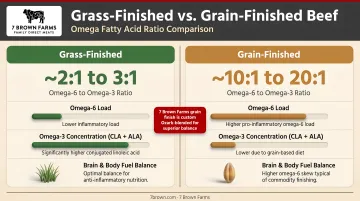
Grass-finished beef demonstrates a significantly healthier Omega-6 to Omega-3 ratio and higher CLA levels—both associated with reduced inflammation and improved cardiovascular health.
Dry-Aging vs. Wet-Aging
Endogenous enzymes cleave structural proteins during the first 14 days of dry-aging, reducing Warner-Bratzler shear force (toughness) by up to 25-30%, significantly improving tenderness. The vast majority of U.S. commodity beef is wet-aged (vacuum-packaged) for speed and to prevent the 15-30% weight loss associated with dry-aging.
7 Brown Farms employs a minimum 14-day dry-aging process for all beef, and offers a 45-day dry-aging service using Italian Stagionello cabinets with University of Florence methods for steakhouse buyers. This extended aging achieves less than 15% shrink loss compared to the industry standard of 20-50%, while developing concentrated, complex beef flavor that wet-aged commodity beef never develops.
Stress Levels Impact Quality
Pre-slaughter stress causes tougher beef. Acute stress from electric prodding and long transport elevates plasma lactate and reduces water-holding capacity, increasing meat toughness independent of pH levels. A 2022 study comparing stationary slaughterhouses to mobile on-farm abattoirs found that mobile slaughter resulted in significantly lower shear force (6.9 N lower), indicating more tender meat due to reduced transport stress.
Who Benefits Most from Farm-Direct Quality
This matters most for consumers already spending money on premium beef at restaurants or specialty grocery stores. Buying direct from the farm that produces that same tier of quality often delivers it at a lower price point—without the retail markup.
Your Dollar Goes Further—and Does More
Without the processor, distributor, and retailer each taking a margin cut, more of what you pay actually reaches the farmer—and what you receive reflects that efficiency in pricing, custom options, and product quality.
The Farm Share Reality
While the average U.S. farmer receives only 11.8 cents of the general food dollar, beef farmers capture 52.2 cents—and direct-to-consumer bulk purchasing bypasses retail markups entirely. For every dollar you spend on grocery store beef, 47.8 cents goes to marketing, processing, distribution, and retail operations. When you buy direct, the farmer keeps that margin and reinvests it in sustainable practices, quality improvements, and fair wages for their team.
Bulk and Custom Purchasing Value
Many farms offer whole, half, or quarter animal options, custom cut sheets, and bulk purchasing that locks in price and quality. In Q1 2026, the average direct-to-consumer hanging weight price for a whole grass-fed beef carcass (excluding processing) was $5.90/lb. Including processing, the average hanging weight price was $8.20/lb, translating to a net product (take-home) weight cost of $12.70/lb.
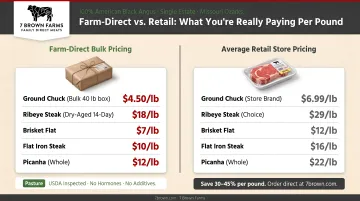
7 Brown Farms offers a 200-pound family freezer drop at $9.00 per pound (regular price $14.00/lb)—a $5.00/lb savings. Each order includes:
- 80–120 lbs of ground beef
- 20–50 lbs of premium steak cuts
- Up to 50 lbs of specialty cuts, all individually wrapped and frozen
Compare that to individual cut pricing: premium steak gift boxes at $22.50/lb, individual ribeyes at $15–22+/lb, or ground beef bundles at $10–12/lb. The bulk option represents a 40–60% savings.
Economic Impact on Rural Communities
Beyond personal savings, buying direct keeps revenue inside rural farming communities. When family farms stay financially viable, they can maintain sustainable practices, humane animal management, and quality standards that industrial operations are structurally pressured to cut. 7 Brown Farms, a seven-generation family farm founded in 1885, reinvests every dollar into sustainable grazing improvements, nutritional quality enhancements, and solutions to demanding pasture climates.
When This Advantage Matters Most
Bulk purchasing delivers highest value for:
- Families feeding multiple people regularly
- Households with chest freezer capacity (15-20 cubic feet for a 200-pound order)
- Buyers already spending premium prices on beef who want that same quality for less per serving
What Happens When You Keep Buying from the Grocery Store Instead
Consumers who default to grocery store beef often pay mid-to-premium prices for commodity-grade product because they lack the information to evaluate what they're actually buying.
Label Confusion and False Assurance
Three common labels — "Natural," "Humanely Raised," and "Product of USA" — carry no enforceable quality or origin standards that most consumers expect them to. Consumers frequently misunderstand "natural" to mean no antibiotics or hormones were used during the animal's life.
The regulatory reality is narrower: "natural" only means the product contains no artificial ingredients and is minimally processed after processing. It does not prohibit hormones or antibiotics during raising — at all.
Here's what those labels actually cover (and don't):
- "Natural" — No artificial ingredients, minimal processing. Hormones and antibiotics during raising are still permitted.
- "Humanely Raised" — No standardized USDA definition. Requires specific third-party certification or an approved label claim to verify anything.
- "Product of USA" — Can apply to beef born and raised abroad, as long as it was processed on U.S. soil.
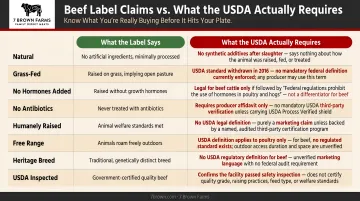
80%+ of consumers believe "humanely raised" claims should not be allowed unless a producer exceeds industry standards. Without that certification, the claim is marketing, not accountability.
Nutritional Inconsistency
Those label gaps don't just affect trust — they affect what ends up on your plate. Commodity beef is routinely blended from multiple sources with varying feed programs, stress levels, and breed quality, producing unpredictable nutritional profiles. One package can contain beef from 400+ different animals with entirely different diets, raising conditions, and processing histories.
No Recourse and No Relationship
When quality disappoints or questions arise, there's no farmer to call — only a corporate 1-800 number and a return policy. With farm-direct purchases, you can reach the actual farmer directly and get real answers about storage, handling, cooking techniques, and cut selection — because they raised the animal and know exactly what you bought.
How to Start Buying Direct from Your Farmer Today
Getting started is straightforward. Identify what matters most to you (breed, feed, certifications, location, price point), then find a farm that meets those standards and reach out directly. Many farms now offer nationwide shipping, so geography won't stop you.
Key Questions to Ask the Farmer
- How are animals raised? (pasture-raised, grain-finished, feed composition)
- What certifications or inspections apply? (look for USDA-inspected operations)
- Are custom cuts or bulk orders available?
- What does the shipping or delivery process look like?
- What is NOT used in raising the animals? (hormones, antibiotics, mRNA vaccines, additives)
- Is this single-source beef or blended commodity product?
What to Look For
- USDA inspection status — confirms federal food safety standards and legal compliance
- Single-source breed identity, not a commodity blend
- Pasture-raised practices with no hormones, no antibiotics, no additives
- Direct, transparent answers — farms selling direct stake their reputation on every order
How 7 Brown Farms Works
For families within 100 miles of St. Mary, MO, 7 Brown Farms offers white-glove appointment delivery. Farmer Brown delivers bulk beef directly into your home or office freezer by appointment, typically within 7–10 days of order confirmation.
The meat arrives safely frozen or near-frozen (below USDA 40°F) without brown boxes or gel packs. Farmer Brown answers storage, handling, and cooking questions on the spot while placing your order into your freezer.
For buyers further out, 7 Brown Farms ships direct nationwide with two-day frozen-tight UPS delivery using Nordic Ice gel packs and/or dry ice. Custom cut sheet options are available for bulk orders—customers work directly with Farmer Brown to specify preferred cuts and allocations based on family preferences and dietary goals.
Buying Direct Rewards Consistency
The most value—financially, nutritionally, and in terms of relationship with the source—comes from making it a regular practice rather than a one-time purchase. When you buy consistently from a trusted farm, you understand what quality actually looks like, you stop settling for less, and you build a direct relationship with the people who raised your food. That's something no grocery aisle can replicate.
Conclusion
Buying direct from your farmer isn't about nostalgia—it's about getting what the grocery store system structurally cannot deliver: true traceability, verifiable quality standards, and a direct relationship with the people responsible for what ends up on your plate.
The advantages of buying direct compound over time. The more consistently you source from a trusted farm, the better you understand what quality actually looks like—and the harder it becomes to accept the alternative. That's a food system built on accountability rather than opacity.
7 Brown Farms, a seven-generation family operation founded in 1885 in the Missouri Ozarks, is built on exactly that principle. Every purchase supports sustainable pasture practices, rural livelihoods, and beef raised with no hormones, antibiotics, mRNA vaccines, or additives.
Frequently Asked Questions
Frequently Asked Questions
Can you buy directly from the farmer?
Yes, buying directly from a farmer is widely available today. Many farms sell through their own websites, farmers markets, and direct shipping, making it accessible whether you live rurally or in a city. 7 Brown Farms, for example, ships nationwide and offers white glove delivery within 100 miles of their Missouri farm.
How do I buy food directly from a farmer?
Identify the beef you're looking for, find a farm that raises it with standards you trust, and ask about ordering options — bulk, custom cut, or individual — plus shipping or pickup availability. To order from 7 Brown Farms, call 314-540-5515 or visit their website.
What are the benefits of buying directly from local farmers?
Key benefits include full traceability and ingredient transparency, fresher and more nutrient-dense product, fair pricing without retail markups, and direct support for family farming operations. You also get access to custom cut sheets and bulk ordering options unavailable at grocery stores.
Is it cheaper to buy from local farmers?
Per-cut pricing can appear similar or slightly higher, but bulk and custom orders often deliver a lower cost-per-pound than equivalent-quality specialty grocery options. 7 Brown Farms' 200-pound bulk order at $9.00/lb represents a 40-60% savings compared to individual premium cuts at $15–22+/lb.
What should I look for when buying beef directly from a farm?
Look for USDA inspection status, breed clarity (single-source vs. commodity blend), feed and management practices (no hormones, no antibiotics), and whether the farm offers transparent answers to direct questions about their process. Ask about dry-aging methods, stress management during processing, and whether the beef is single-estate sourced or blended from multiple farms.
Does buying direct from a farmer mean better quality beef?
Generally yes. Farms selling direct have a reputational and financial stake in every product they ship, unlike commodity processors that aggregate from many sources. Skipping industrial shortcuts — blending, speed wet-aging, additives — typically delivers better marbling, tenderness, and flavor.