The idea sounds simple, but the process involves real decisions. You need to find the right farm, understand buying options (individual cuts versus bulk shares), ask the right questions, and budget correctly. First-time buyers often underestimate freezer space, overlook processing fees, or skip quality vetting entirely.
This guide walks through the exact steps to buy meat direct from a farmer, what to look for in a quality source, and the most common mistakes to avoid.
Key Takeaways
- Direct buying cuts out middlemen—your money goes to the farmer and you get full traceability
- Buy by the cut for flexibility with no bulk commitment, or by the share (whole, half, or quarter animal) for a lower per-pound price with upfront freezer space required
- Verify USDA inspection status and ask about feed and raising practices before committing
- Total cost includes processing fees and butcher costs, not just the per-pound hanging weight price
- Many farms ship nationwide—geography is far less of a barrier than most buyers expect
Why Buy Meat Direct from a Farmer
Buying direct means eliminating commercial middlemen—processors, distributors, retail chains—so money flows directly to the farmer and you get complete visibility into sourcing. That visibility matters because industrial supply chains are built to obscure origin. Labels like "natural" carry no standardized federal definition, and the USDA withdrew its grass-fed marketing standard in 2016 — leaving producers to either set their own qualifying standards or lean on third-party certifications.
The nutritional gap is measurable. A 2026 study in the Journal of Animal Science found that grass-fed beef had a lower omega-6 to omega-3 ratio (2.14) compared to grain-fed beef (8.28), alongside higher concentrations of conjugated linoleic acid (0.49% vs. 0.31%). These ratios directly impact inflammation markers and cardiovascular health.
Core benefits include:
- Better flavor from animals raised with quality feed in low-stress environments
- Superior nutrition through controlled omega ratios and higher CLA content
- Complete traceability — you know exactly how your food was raised, who raised it, and where
- No hormones, antibiotics, or misleading grocery store labels to decode
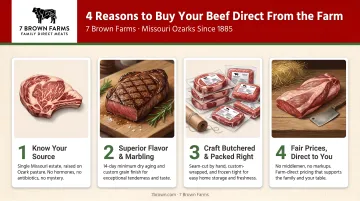
If any of the above resonates, direct buying is likely a good fit. It's particularly well-suited for families who prioritize clean protein, athletes fueling performance with nutrient-dense food, and anyone who's grown tired of grocery labels that tell you nothing useful about what's actually in the package.
How to Buy Meat Direct from a Farmer: Step-by-Step
Step 1: Find a Reputable Farm
Main channels for finding farms:
- Local farmers markets (direct contact, immediate product availability)
- Farm websites and online stores (many ship nationwide)
- Directories like EatWild.com, ChopLocal.com, and LocalHarvest.org
- Social media farm pages (Facebook/Instagram show day-to-day operations)
- USDA Local Food Directories (searchable public directories for direct-market farms)
- Local agricultural extension offices
Most farms now ship nationwide, so location rarely limits your options.
7 Brown Farms in the Missouri Ozarks is a good example of what to look for. They raise 100% American Black Angus on a single estate, welcome direct contact with the farmer (314-540-5515), and ship nationwide. All beef is raised without hormones, antibiotics, or additives, with a minimum 14-day dry age.
Step 2: Verify Quality and Transparency Standards
Key credibility signals to check:
- USDA inspection status (mandatory for all cut meat sold commercially)
- Raising practices (pasture access, feed type, breed)
- Transparency (farm welcomes questions, provides photos, allows visits)
What certifications actually mean:
- USDA inspection: Legal requirement, federally verified, ensures meat is safe and properly labeled
- "Natural": Regulated by USDA FSIS, means no artificial flavors, colorings, or chemical preservatives—but processing can still be industrial
- "Pasture-raised" / "Humanely raised": Unregulated by federal definition—producers must describe their own standards or use third-party certification
- "Organic": Enforced by USDA National Organic Program, requires 100% certified organic feed, no antibiotics or hormones, year-round outdoor access
Step 3: Choose Your Buying Format (Cut vs. Share)
You have two primary options:
- Individual cuts: Flexible, no storage requirements, higher per-pound cost
- Bulk shares: Whole, half, or quarter animal—lower per-pound cost, requires freezer space and larger upfront payment
This is covered in detail below.
Step 4: Place Your Order and Understand the Process
How bulk/share orders typically work:
- Place a deposit to reserve the animal
- The farm sends the animal to a USDA-inspected processor or custom butcher
- You fill out a cut sheet specifying steak thickness, ground beef percentage, roast vs. ribs, etc.
- Receive packaged meat after processing
Understanding weight measurements:
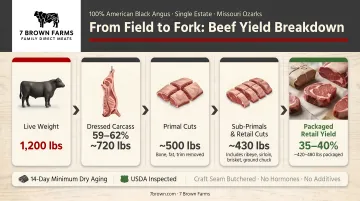
Most farms price by hanging weight (the weight of the carcass after slaughter but before cutting). Final take-home weight (packaged cuts) will be less.
Typical yield benchmarks:
- Live weight to hot carcass: 60-64% (dressing percentage)
- Chilling shrink: 2-5% of hot carcass weight
- Carcass cutting yield: 65-70% of chilled carcass becomes packaged cuts
Example: A 1,400 lb steer yields approximately 880 lbs hot carcass weight, ~840 lbs chilled weight, and ~570 lbs of packaged retail beef.
Once your order is packaged, you'll typically have three delivery options:
- Local farm pickup: Arrange a pickup time directly with the farm
- White-glove delivery: Farms like 7 Brown Farms deliver within 100 miles of their Missouri location, placing meat directly into your freezer
- Nationwide frozen shipping: Standard 2-day frozen-tight delivery for orders outside local range
Buying by the Cut vs. Buying by the Share
Individual Cut Purchases
Same model as a grocery store — but direct from the farm. You select specific cuts (ribeye, ground beef, brisket) without any bulk commitment. Per-pound prices run higher than shares, but there's no large upfront cost or freezer requirement. A good starting point if you're testing a farm before going all-in on bulk.
Bulk Shares (Whole, Half, or Quarter Animal)
A bulk share is a single large purchase where a butcher processes the entire portion to your specifications via a cut sheet. You receive every part of that portion — including less popular cuts like organ meat, bones, and shanks you wouldn't typically choose individually. Always clarify with the farm exactly what's included before ordering.
Typical packaged weight ranges:
- Whole beef: ~500-570 lbs of packaged meat
- Half beef: ~249-285 lbs of packaged meat
- Quarter beef: ~125 lbs of packaged meat
Plan on 1 cubic foot of freezer space per 35-40 lbs of packaged meat — which translates to:
- Whole beef: ~15 cubic feet
- Half beef: ~8 cubic feet
- Quarter beef: ~4 cubic feet
The per-pound price on bulk shares runs meaningfully lower than buying individual cuts, even with the upfront cost factored in. Splitting a half or whole with another household keeps both the cost and the freezer space manageable.
One advantage that carries through both buying methods: custom cut sheets. 7 Brown Farms offers them for all bulk orders, letting you specify cuts, thickness, packaging size, and specialty processing such as extended dry-aged primals — a level of control you simply don't get at retail.
Key Questions to Ask a Farmer Before Buying
The single biggest advantage of buying direct is that you can talk to the farmer. Use that access. A good farmer is proud to answer them.
What are the animals fed, and what breed are they?
Breed affects marbling and flavor — Black Angus, for example, is known for superior marbling. Feed affects nutrition just as much. Ask whether the animals are grass-fed, grain-finished, or both, and for how long. Grass-fed beef delivers a better omega-6:omega-3 ratio; grain-finished beef offers richer marbling. Both have distinct profiles worth knowing before you buy.
Are the animals raised without hormones, antibiotics, or other additives?
This is a quality and health consideration. Ask specifically, since terms like "hormone-free" are not always federally verified unless accompanied by USDA inspection. If it matters to your family, ask directly about mRNA vaccines and any other additives. A transparent farm will give you a straight answer on all of it.
Is the meat USDA inspected?
All cut meat sold commercially must be USDA inspected. Meat sold "by the share" — where you technically own the live animal — may be processed under state regulations that vary by state. Both options can be safe, but confirm which applies to your purchase before committing.
How is the meat processed and packaged?
Ask about:
- The processor used
- Aging method (dry-aged vs. wet-aged, and for how long)
- How cuts are wrapped and frozen
These factors directly affect flavor and shelf life. Dry-aging concentrates flavor and tenderizes the cut — 14 days is a reasonable minimum to ask about; serious operations go longer.
Can I visit the farm or see photos of how the animals are raised?
A legitimate, quality-focused farm will welcome this. It's the most direct way to verify the operation matches what the farmer describes.
What to Know About Pricing and Total Cost
The per-pound price a farmer quotes — often based on hanging weight for bulk orders — is not your total cost. You also pay the butcher separately for processing (cutting, wrapping, smoking/curing) and may owe a delivery fee on top.
Processing fees (2026):
- Slaughter fee: $100-$150 per head
- Processing (cut & wrap): $0.57-$1.25 per lb hanging weight
How hanging weight pricing works:
Hanging weight is the weight of the carcass before it is cut into individual pieces. Final take-home weight will be 65-70% of hanging weight. Ask the farm for an estimated yield so you can calculate actual cost per pound of meat in hand.
Those numbers matter when you compare farm-direct pricing to what you'd pay at the grocery store.
Price comparison to grocery store meat (February 2026):
| Source | Product Type | Price ($/lb) |
|---|---|---|
| USDA ERS (Grocery) | All-fresh beef retail | $9.63 |
| USDA ERS (Grocery) | Choice beef retail | $10.12 |
| USDA ERS (Grocery) | Ground beef | $6.74 |
| USDA AMS (Farm-Direct) | Grass-fed half beef (net product weight) | $12.63 |
| USDA AMS (Farm-Direct) | Grass-fed ground beef (90%+) | $13.19 |
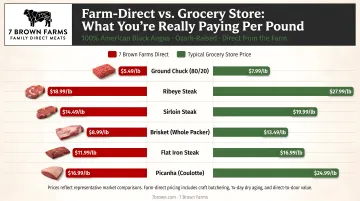
Farm-direct premium beef does cost more per pound than supermarket meat. Bought in bulk, the gap narrows — and you're getting full traceability, no commodity blending, and beef raised to your standards rather than a distributor's.
Strategies for managing cost:
- Buy a quarter instead of a half
- Split with another household
- Prioritize farm-direct for premium cuts; supplement with store-bought for dishes where quality is less noticeable
Common Mistakes First-Time Buyers Make
Avoid these four pitfalls before you place a deposit:
- Hidden processing fees: Most first-time buyers fixate on the per-pound price and miss butcher and processing costs. Ask for a full cost breakdown upfront — total price, not just hanging weight.
- Underestimating freezer space: A half beef yields 200+ pounds of packaged meat. Measure your available freezer capacity before committing, or plan to buy a chest freezer in advance.
- Skipping quality vetting: Small and local doesn't guarantee high quality. Confirm USDA inspection, ask about feed and raising conditions, and verify how the animal is processed before you buy.
- Leaving the cut sheet to chance: Handing all decisions to the butcher can leave you with thicknesses or package sizes that don't fit how you cook. Review your cut sheet options and communicate your preferences clearly.
Conclusion
Buying meat direct from a farmer gives you something industrial retail cannot: full transparency, a direct relationship with the person raising your food, and real control over what ends up on your table. But the results depend entirely on choosing the right farm, asking the right questions, and understanding the process before you buy.
The most common failures come from under-preparation—not budgeting for total costs, not planning for storage, and not vetting the farm's practices. Farms like 7 Brown Farms—USDA inspected, single-estate, with Farmer Brown reachable directly at 314-540-5515—show exactly what a transparent operation looks like. That's the standard worth holding every farm to.
Three steps to get started on the right foot:
- Order individual cuts first to test quality before committing to a bulk purchase
- Talk to the farmer directly — if they're hard to reach before the sale, that's a red flag
- Look for clear quality signals: USDA inspection, transparent raising practices, and a willingness to answer your questions
Frequently Asked Questions
Frequently Asked Questions
How can I buy meat directly from a farmer?
Order through a farm's own website — many, like 7 Brown Farms, ship nationwide — or shop at local farmers markets and use directories like EatWild.com or ChopLocal to find farms near you. You can buy individual cuts or bulk shares depending on your needs.
What is the difference between buying meat by the cut and buying by the share?
Buying by the cut means purchasing individual portions (steaks, roasts) at a higher per-pound price with no bulk commitment. Buying by the share means purchasing a whole, half, or quarter animal at a lower per-pound price — but it requires a larger upfront payment and adequate freezer space.
Is it safe to buy meat directly from a farm?
Farm-direct meat is equally safe to grocery store meat when purchased from a USDA-inspected source — confirm that status before buying. Standard home freezing and safe handling practices apply just as they would with any meat.
How much freezer space do I need to buy a half or whole animal?
You need approximately 1 cubic foot of freezer space per 35–40 lbs of packaged meat. A half beef (~250 lbs) requires roughly 8 cubic feet, while a whole beef (~550 lbs) requires about 15 cubic feet.
What questions should I ask a farmer before buying meat?
Ask about USDA inspection status, what the animals are fed and how they are raised, whether hormones or antibiotics are used, how the meat is processed and aged, and whether a farm visit or photos are available.
Is farm-direct beef more expensive than grocery store beef?
Per-pound, premium farm-direct beef typically runs higher than industrial supermarket prices — but bulk shares close that gap considerably. You're also paying for verified raising practices, USDA inspection, and dry aging that grocery store commodity beef rarely includes.