Introduction
Standing at a butcher counter or scrolling through an online meat shop, you're bombarded with cut names, USDA grades, and bold claims—all promising "the best." Ribeye, strip, filet, Prime, Choice, dry-aged, grass-fed. The options multiply, the prices climb, and the confusion deepens. Many buyers end up choosing by price alone or defaulting to whatever sounds most luxurious, often walking away disappointed despite paying premium prices.
The right cut, paired with the right cooking method and quality source, transforms a meal into an experience. A poor choice, even at a premium price, delivers dry, flavorless disappointment. This guide explains what makes a cut truly premium, how USDA grades actually work, which cuts deliver which qualities, and how to choose the right steak for your situation.
TL;DR
- Cut location determines tenderness: less-worked muscles (loin, rib) outperform high-activity ones
- Each premium cut has a strength: filet mignon = tenderness, ribeye = richness, NY strip = balance
- USDA Prime (roughly 11% of graded beef) signals abundant marbling; Choice is solid; Select runs lean
- Dry aging, Black Angus genetics, and farm practices shape flavor as much as the grade label does
- Your top priority — tenderness, bold flavor, or value — is the clearest filter for choosing a cut
What Makes a Steak Cut "Premium"?
Premium doesn't just mean expensive. It refers to the combination of three measurable factors: cut location, intramuscular fat distribution (marbling), and minimal connective tissue. Cuts from the loin and rib sections dominate the premium tier because those muscles do little work during the animal's life—less activity means less connective tissue and more tenderness.
Three quality axes every buyer should understand:
- Tenderness: How soft the steak feels when you bite into it
- Marbling: Fat woven into the muscle (not external trim)
- Flavor intensity: Often inversely related to tenderness
The most tender cuts—like filet mignon—are milder in flavor. The most intensely flavored cuts—like ribeye—have more chew due to higher fat content. There's no "best" cut, only the best cut for your priorities.
Cut location only tells part of the story. Two ribeyes at the same USDA grade can taste dramatically different depending on whether the cattle were grass-finished, grain-finished, or dry-aged.
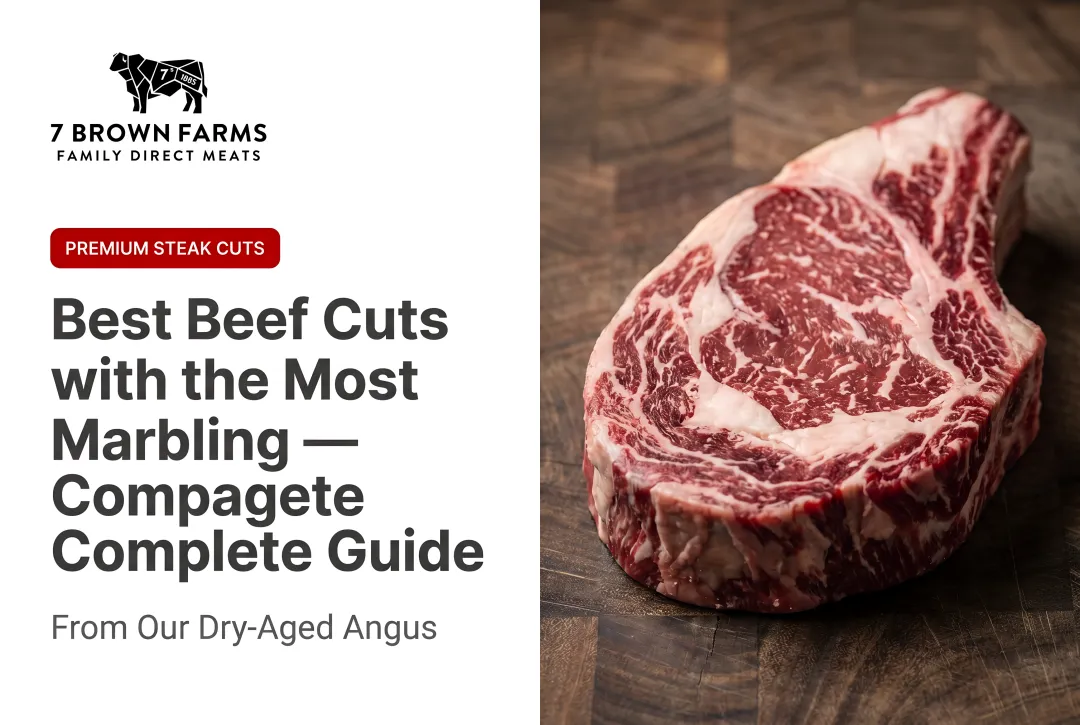
A Black Angus ribeye from a single estate — raised on a custom grain finish like those developed for Missouri Ozarks pasture conditions — can achieve marbling that rivals or exceeds commodity Prime. The breed, feed program, and processing method matter as much as which part of the animal the steak came from.
Understanding USDA Beef Grades and Quality Markers
The USDA beef grading system is the official quality standard in the U.S. Graders assess yield and quality, with quality grades being most relevant to consumers. Grading is voluntary, meaning producers pay for it. Ungraded beef exists with no quality assurance.
The five consumer-facing grades work like this:
- USDA Prime — Abundant marbling; only ~11.3% of graded beef qualifies. Found mainly at high-end steakhouses, not standard grocery stores.
- USDA Choice — Most widely available premium grade, with moderate to modest marbling. High-end Choice from heritage breeds can approach Prime quality, especially with rigorous feeding programs.
- USDA Select — Leaner, less marbling; better suited to slow cooking or marinating than dry-heat grilling.
- Standard & Commercial — Rarely sold as whole steaks to consumers.
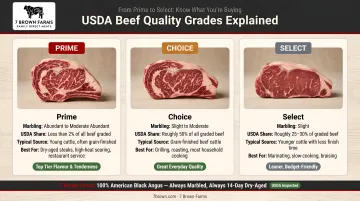
A Choice ribeye from a quality-raised breed and known farm can outperform a Prime label from a commodity operation. Grade alone doesn't tell the full story.
Marbling score (Beef Marbling Score, or BMS) is the most important sub-metric within grading. It measures the amount and distribution of intramuscular fat within the ribeye between the 12th and 13th ribs. Marbling accounts for 14–21% of variation in consumer palatability scores.
Wagyu and American Black Angus tend to score higher due to breed genetics and feeding programs. A well-raised Black Angus with a custom grain finish — like the single-estate cattle 7 Brown Farms raises in the Missouri Ozarks — can achieve marbling levels that rival or exceed commodity Prime, without the blended sourcing that obscures traceability.
Top Premium Steak Cuts Explained
Premium cuts come from the rib and loin sections of the animal. Each cut occupies a different position on the tenderness-flavor-fat spectrum, meaning "best" is always relative to your priorities.
Filet Mignon (Tenderloin)
The most tender steak available, cut from the tenderloin—a muscle running along the spine that does almost no work. The psoas major muscle delivers the lowest Warner-Bratzler Shear Force (around 2.6 kg), making it tender with minimal connective tissue. The trade-off: less beefy intensity compared to fattier cuts because it's lean.
Best for: Those prioritizing texture over fat, first-time premium steak buyers, formal or special-occasion meals where elegant presentation matters. It carries the highest per-ounce price of any steak cut.
Cooking: High-heat searing or sous vide to rare or medium-rare.
Ribeye and Prime Rib
Ribeye comes from the rib section (ribs 6–12), the richest and most heavily marbled of all premium cuts. Marbling melts during cooking, basting the meat from within and producing deep, buttery, beefy flavor. Available bone-in (cowboy cut, tomahawk) or boneless. Bone-in versions add flavor and drama; boneless cooks more evenly.
Prime rib is the same rib section cooked as a roast (ribs intact) rather than cut into individual steaks. Slow-roasting allows fat to render gradually, creating exceptional juiciness.
Important: "Prime rib" refers to the cut and preparation method, not necessarily USDA Prime grade. A "prime rib" can legally be graded Choice or Select.
Best for: Buyers wanting maximum flavor and richness, comfortable with a fattier eating experience.
Cooking: High-heat grilling, broiling, or cast-iron searing to medium-rare.
New York Strip, Porterhouse, and T-Bone
New York strip (short loin) is the balanced premium cut: moderate marbling, firm chew, bold beefy flavor without the fat load of a ribeye. It suits first-time premium steak buyers and experienced eaters equally well.
Porterhouse and T-bone are two-in-one cuts that include both the strip and the tenderloin, separated by a T-shaped bone. The key difference: a porterhouse has a tenderloin width of at least 1.25 inches measured parallel to the backbone; a T-bone requires only 0.5 inches. The porterhouse is cut from further back in the loin and offers more tenderloin.
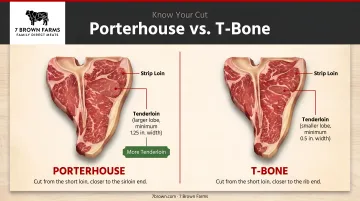
Best for: Those wanting to experience multiple textures in a single cut, sharing, or showstopper presentation.
Cooking: Grilling or broiling preferred (the bone makes pan-searing difficult).
Value-Premium Cuts: Flat Iron and Top Sirloin
Flat Iron is cut from the top blade of the shoulder (infraspinatus muscle). It's the second most tender cut after filet mignon (WBSF ~2.7 kg), well-marbled and comparable in texture to a strip steak but at a lower price. It has a thin strip of gristle through the center that should be removed before cooking.
Best for: Buyers seeking premium flavor and tenderness at a more accessible price point.
Where the flat iron leads on tenderness, top sirloin leads on leanness — sitting at the transition between the loin and hip, it's the lightest-eating option in this category. It offers solid beefy flavor with firmer texture. Clarification: Top sirloin (premium, grillable) is different from bottom sirloin or generic sirloin (tougher, better for slow cooking).
Best for: Health-conscious buyers or those preferring a leaner eating experience.
How Dry Aging Elevates Premium Cuts
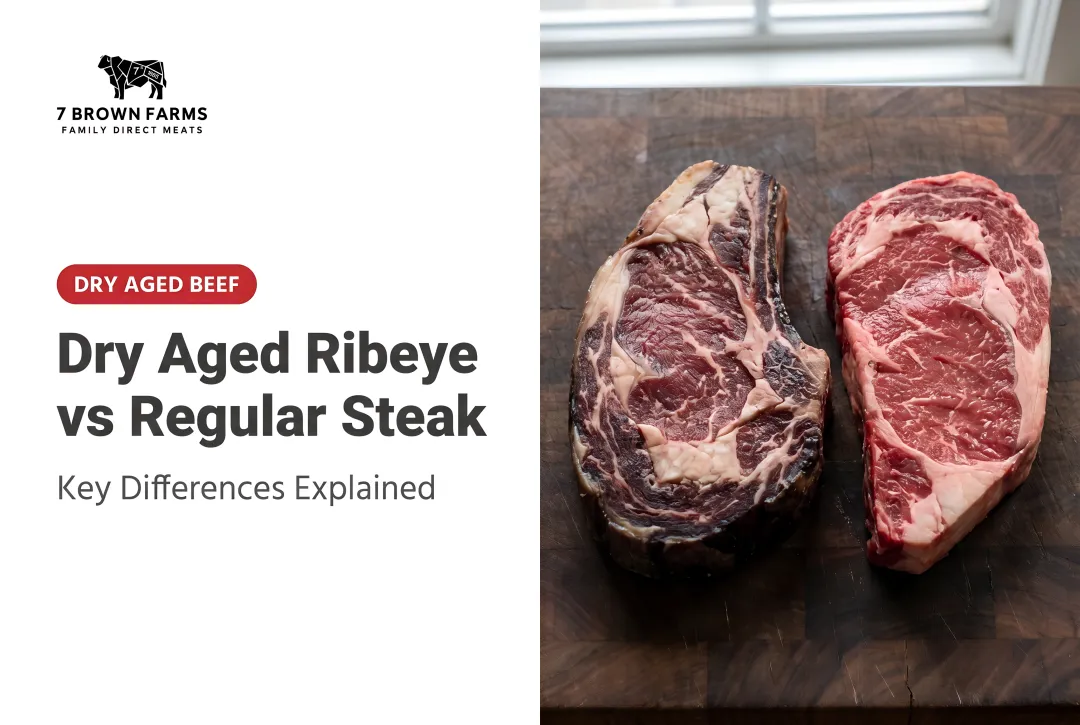
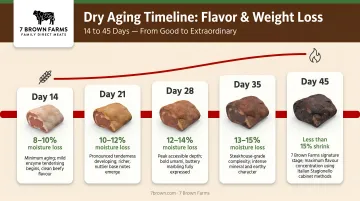
Dry aging is the controlled process of storing beef uncovered in a temperature- and humidity-regulated environment for 14 to 45+ days. During this time, moisture evaporates (concentrating flavor) and natural enzymes break down muscle fibers (increasing tenderness). The result: a more intensely beefy, nutty flavor and noticeably more tender texture compared to wet-aged or fresh beef. The outer crust (pellicle) is trimmed before sale, accounting for weight loss, as detailed in this PMC review of dry aging research.
14-day vs. 45-day dry aging:
- 14 days: Improves tenderness measurably and adds subtle flavor depth
- 30–45 days: Produces pronounced nutty, umami complexity preferred by steakhouses and serious buyers
Weight loss climbs steadily throughout the process: roughly 5–6% at 14 days, ~15% by 30 days, and over 23% at 45–50 days, according to published dry aging research. That progressive moisture loss is why properly aged beef carries a higher price tag.
Important: Dry aging is only worth pursuing on high-marbled cuts (ribeye, strip, porterhouse). Leaner cuts lack the fat structure to benefit fully, so the quality of the base cut determines the outcome.
7 Brown Farms uses an Italian Stagionello dry aging cabinet following University of Florence protocols, achieving less than 15% shrink loss on primals. That efficiency means full dry-aged flavor without the excessive waste that drives up cost on lesser-managed operations.
How to Select the Right Premium Cut for Your Needs
Three core questions to ask yourself:
- What texture do I want? Melt-in-your-mouth or satisfying chew?
- How much fat/richness am I comfortable with?
- What cooking method will I use?
Match questions to cuts:
- Tenderness-seekers → Filet mignon
- Richness-seekers → Ribeye or prime rib
- Balance-seekers → NY strip
- Sharing/occasion → Porterhouse or tomahawk
- Lean/health-focused → Top sirloin or flat iron
Cooking method as a filter:
Most premium cuts respond best to dry heat. Here's how method maps to cut:
- Ribeye, NY strip: Ideal for grilling, searing, or broiling — fat renders beautifully under high heat
- Top sirloin, flat iron: Grill well but shouldn't go past medium to avoid drying out
- Tenderloin: Forgiving — works on the grill, in a cast iron, or under the broiler
- Bone-in cuts (porterhouse, T-bone): Better grilled or broiled than pan-seared; the bone conducts heat unevenly in a pan
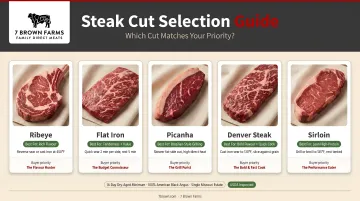
Your cooking setup narrows the field quickly. Once you know the method, budget and occasion make the final call.
Occasion and budget:
Filet mignon and tomahawk are high-impact, high-cost cuts built for special meals. NY strip and flat iron deliver premium quality at a price that works for regular consumption. Buying direct from a farm source — such as 7 Brown Farms' bulk order program — often yields better per-cut value, full transparency on how the beef was raised, and options like custom thickness or dry-aging specifications that retail can't match.
Sourcing quality:
The same cut name on different packages can represent noticeably different flavor and texture depending on breed, feed program, and processing. Look for:
- Single-estate sourcing (not blended lots)
- Known breed (Black Angus is a reliable quality indicator)
- No added hormones or antibiotics
- USDA inspection confirmation
A region-specific grain finish — like the Ozark-formulated program used at 7 Brown Farms — produces marbling and flavor depth that commodity beef can't match.
Common Mistakes When Buying Premium Steak
Confusing "Premium Price" with "Premium Quality"
Marketing terms like "butcher's choice," "ranch raised," or "natural" have no regulated definition. The FSIS defines "natural" strictly as containing no artificial ingredients or added color and being minimally processed—it does NOT mean hormone-free or antibiotic-free, though 60% of consumers mistakenly believe it does. Without a USDA grade, breed designation, or known farm source, high-priced beef can still be commodity-quality.
Before buying, ask the seller:
- What USDA grade is this?
- What breed is it, and where was it raised?
- Was it dry-aged or wet-aged — and for how long?
Choosing a Cut Based on Name Alone
Many buyers default to filet mignon because it sounds luxurious, but if they prefer bold, beefy flavor and plan to grill, a ribeye or NY strip will deliver a more satisfying result. Match the cut to your preference and cooking method, not just its reputation.
Overlooking Thickness and Aging
A 1-inch ribeye and a 2-inch ribeye cook very differently. Thin-cut premium steaks often overcook before reaching proper internal temperature. Aging has an equal impact: a wet-aged Choice strip and a 45-day dry-aged Prime strip are entirely different products by the time they reach the plate, even if labeled similarly.
When sourcing premium beef, ask for the age time upfront and request thick-cut portions — farms that process in small craft batches, like 7 Brown Farms, typically list both transparently.
Frequently Asked Questions
What are the top 5 best cuts of steak?
The five most widely recognized premium cuts are filet mignon (tenderness), ribeye (richness and marbling), New York strip (balanced flavor and texture), porterhouse (dual-texture with both strip and tenderloin), and T-bone (similar to porterhouse but smaller tenderloin portion).
What is the most premium steak cut?
Filet mignon is typically considered the most premium due to its extreme tenderness and highest price per ounce. However, ribeye rivals it in the eyes of many steak enthusiasts for its superior flavor and marbling. Your priority — tenderness or flavor — is the deciding factor.
What are the 5 quality grades of beef?
The five USDA quality grades are Prime (highest marbling, ~11% of graded beef), Choice (moderate marbling, most commonly available), Select (leaner, less flavor), Standard (very lean, often ungraded), and Commercial (older cattle, used for processed products).
Is flat iron steak or sirloin better?
Flat iron is generally more tender and better marbled than top sirloin, making it preferred for grilling or pan-searing. Top sirloin is leaner and works well for those who prefer a lower-fat cut with solid beefy flavor.
What steaks are good for high cholesterol?
Top sirloin, flank steak, and tenderloin are the leanest premium options with lower saturated fat. Top sirloin has 5.6g total fat and 2.1g saturated fat per 3 oz cooked serving; tenderloin has 7.0g total fat and 2.8g saturated fat. Grass-finished or balanced grain-finished beef with a healthier Omega-6 to Omega-3 ratio may be a better choice than commodity beef for those monitoring cholesterol. Farms like 7 Brown Farms that raise Black Angus without hormones, antibiotics, or additives — and finish for Omega balance — offer a cleaner option for health-conscious buyers.
What are the fanciest cuts of beef?
Filet mignon, tomahawk ribeye, porterhouse, and Wagyu-grade cuts are most associated with fine dining and luxury. A 45-day dry-aged Prime ribeye from a single-estate producer will always command more prestige than a generic Select ribeye — regardless of thickness.