How to Smoke Flat Iron Steak — Complete Guide
Flat iron steak is one of beef's most underrated cuts. Sourced from the shoulder (chuck primal), it ranks as the second-most tender muscle on the entire beef carcass—right behind the tenderloin. This cut boasts exceptional marbling and intramuscular fat, making it a natural candidate for low-and-slow smoking.
Getting the best results depends on four variables: steak thickness, prep approach, temperature control, and wood choice. Small adjustments to these factors separate good from great.
Starting with quality beef matters here. 7 Brown Farms raises 100% American Black Angus on a single Missouri estate—always marbled, 14-day dry-aged, no hormones or antibiotics—and that foundation shows up in the finished cook.
This guide will walk you through the entire process—from selecting and preparing your steak to smoking, resting, and serving it perfectly.
Key Takeaways
- Flat iron steak is ideal for smoking thanks to its marbling and tenderness—but the steak should be at least 1 inch thick to benefit from low-and-slow heat
- Smoke at 225°F for approximately 45–60 minutes, targeting 130–135°F internal temperature for medium-rare
- Dry brine for 2–4 hours before smoking to enhance flavor and moisture retention
- Use a reliable instant-read or probe thermometer—flat iron moves quickly from perfect to overcooked
- Rest for at least 10–15 minutes before slicing against the grain
Before You Start: Choosing and Preparing Your Flat Iron Steak
Thickness Requirements
Flat iron steaks under 1 inch are better suited to high-heat grilling. Smoking works best on cuts that are 1 inch or thicker, as thinner cuts cook through too quickly to absorb any real smoke flavor and risk drying out before developing a proper bark.
If you're buying flat iron from a butcher or farm, ask for thicker cuts or seek out whole flat iron primals that can be portioned to your preferred thickness. A 1.5-inch flat iron is ideal for the reverse sear method (more on that below).
Beef Quality Matters
Beef quality directly affects smoking results. A well-marbled flat iron from pasture-raised cattle will render fat during the low-and-slow cook, keeping the steak moist in ways a lean, commercial cut simply cannot replicate.
7 Brown Farms dry-ages every flat iron a minimum of 14 days and finishes their Black Angus on a custom grain diet — two factors that directly improve moisture retention and fat rendering on the smoker.
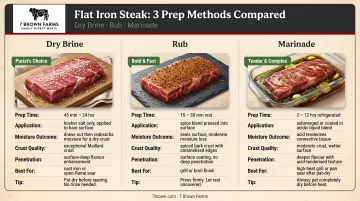
Prep Approaches: Dry Brine, Rub, or Marinade
You have three main prep options:
1. Dry Brine Only
- Apply coarse kosher salt to both sides of the steak
- Refrigerate uncovered for 2–4 hours
- Salt dissolves muscle proteins to form a gel that traps moisture, reducing cook loss
- Creates a dry surface pellicle essential for smoke adhesion and Maillard browning
2. Dry Brine + Oil and Rub
- Dry brine as above for 2–4 hours
- Coat with a thin layer of oil (olive, avocado, or neutral)
- Apply your seasoning rub (black pepper, garlic powder, smoked paprika, etc.)
- Let rest 4–8 hours before smoking
3. Wet Marinade Overnight
- Combine oil, rub, and optional acidic component (vinegar, citrus, Worcestershire)
- Marinate covered in the fridge overnight
- Pat steak dry with paper towels before smoking to allow proper smoke penetration
For most flat irons going straight onto the smoker, dry brining + rub gives you the most consistent bark and smoke ring — which is exactly what the next step is designed around.
How to Smoke Flat Iron Steak — Step by Step
Step 1: Season and Rest the Steak Before Smoking
Pat the steak dry with paper towels. Surface moisture impedes smoke absorption and delays the Maillard reaction during any finishing sear.
Apply coarse kosher salt as a dry brine and refrigerate uncovered for 2–4 hours minimum. Skipping this step costs you moisture retention and surface texture — both matter on a lean cut.
After the dry brine:
- Coat the steak lightly with oil and apply your seasoning rub on both sides
- Pull it from the fridge 30–45 minutes before smoking to approach room temperature for more even cooking
Marinated overnight? Pat dry before placing on the grate — the surface needs to be dry regardless of prep method.
Step 2: Set Up the Smoker
Preheat the smoker to a stable 225°F before placing the steak inside. Consistency matters more than the type of smoker — offset, pellet, kamado, and electric all produce good results. Temperature swings are the enemy of predictable results on a thin cut like flat iron, so dial it in before the steak goes on.
Wood Selection
Choose wood based on the flavor profile you want:
- Mesquite: Bold, beefy, earthy flavor. Best for thicker cuts and experienced smokers. Use sparingly—mesquite can become overwhelming on a steak cooked for under an hour.
- Pecan: Mild, slightly sweet, nutty. Pairs well with beef rubs and is the most approachable choice for first-time attempts.
- Hickory: Strong, classic BBQ flavor. A reliable middle-ground option.
Add only enough wood for approximately 1 hour of smoke. This is not a long cook, and over-smoking will produce a bitter, acrid crust.
Aim for thin blue smoke rather than thick white smoke. Blue smoke indicates efficient combustion and delivers the best flavor without depositing creosote or ash on the meat.
Step 3: Smoke the Steak to Target Temperature
Place the steak directly on the grate (not wrapped) and insert a probe thermometer to monitor internal temperature without opening the smoker repeatedly.
At 225°F, a 1-inch flat iron will typically reach 130°F in approximately 45–60 minutes.
Doneness Temperature Table:
| Doneness | Internal Temperature |
|---|---|
| Rare | 120–130°F |
| Medium-Rare | 130–135°F |
| Medium | 135–145°F |
| Medium-Well | 145–155°F |
Note: Well-done is not recommended for flat iron. Research on the infraspinatus muscle shows shear force (toughness) increases significantly when cooked above 160°F, destroying the cut's key selling point—tenderness.
Optional Smoke-and-Sear (Reverse Sear) Finish
If you want a proper crust alongside the smoke flavor, pull the steak early and finish it over high heat. Pure smoking produces great flavor but a soft exterior — the reverse sear fixes that.
- Remove the steak at ~110–115°F
- Let the smoker or a separate grill/cast iron skillet reach 500°F+
- Sear 1–2 minutes per side to develop a crust
- Monitor temp to hit the final target (130–135°F for medium-rare)
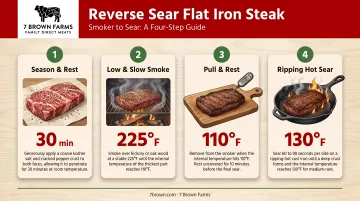
The reverse sear method, popularized by J. Kenji López-Alt, provides edge-to-edge even cooking, eliminates the gray band of overcooked meat, and delivers superior crust formation.
Step 4: Rest, Slice, and Serve
Rest the steak on a cutting board, loosely tented with foil, for 10–15 minutes. Resting allows juices to redistribute. Cutting too early causes significant moisture loss, especially on a lean-to-moderate cut like flat iron.
Slicing Direction
Slice against the grain. The muscle fibers in flat iron steak run uniformly in one direction. Cutting against the grain shortens these fibers into bite-sized segments, making the meat significantly easier to chew.
Serving Ideas
Smoked flat iron is versatile:
- Serve as whole individual steaks
- Slice thin over salads
- Use for fajitas and tacos—the smoke flavor pairs well with bold toppings
Key Parameters That Affect Your Results
Flat iron is thin, quick-cooking, and surprisingly easy to over-smoke. These four variables are where most cooks go wrong — and where small adjustments make the biggest difference.
Smoker Temperature
225°F is the sweet spot. It keeps the cook long enough for smoke absorption without pushing the steak past medium-rare too quickly. Go above 250°F and the window between underdone and overcooked collapses fast on a cut this thin.
Temperature consistency matters just as much as the set point. Fluctuating temps produce uneven doneness from edge to center, which is hard to fix once it happens.
Steak Thickness
Thickness determines how long the steak spends in the smoke. A ¾-inch steak at 225°F may hit 130°F in under 30 minutes — not enough time for meaningful smoke penetration.
Use this as a general guide:
- 1 inch or thicker: Low-and-slow smoking works well
- ¾ to 1 inch: Reverse sear is more reliable
- Under ¾ inch: Grill hot and fast; skip the smoker entirely
Wood Type and Volume
Over-smoking is a real risk on flat iron. The moderate cook time means too much wood, especially mesquite, can produce a bitter, acrid crust that overwhelms the beef's natural flavor.
Limit smoke wood to 1–2 chunks or a light load of chips. Aim for thin blue smoke rather than thick white billows to avoid bitter creosote deposits.
Internal Temperature Monitoring
Flat iron has almost no margin for error. Above 145°F the texture begins to tighten, and above 155°F the cut loses its tenderness entirely.
A calibrated instant-read or wireless probe thermometer is non-negotiable. Steak thickness varies widely, and cook time alone won't tell you what you need to know. A thermometer is the only reliable way to hit the right doneness every time.
Common Mistakes When Smoking Flat Iron Steak
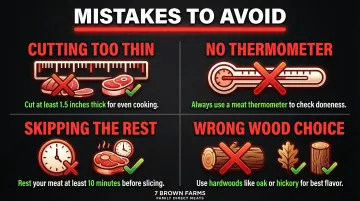
Most flat iron smoking problems fall into four categories:
- Cut too thin — steaks under 1 inch overcook before the smoke does anything useful
- No thermometer — color and timing lie; internal temp doesn't
- Skipped rest — cuts the steak too soon and drives moisture out
- Wrong wood — aggressive woods like mesquite overwhelm a short cook
Smoking a Steak That's Too Thin
A steak under 1 inch doesn't benefit from 45 minutes in a 225°F smoker. It overcooks before it absorbs any noticeable smoke flavor. Ask your butcher for cuts at least 1 inch thick, or look for a whole flat iron you can portion yourself.
Overcooking Due to Skipped Thermometer Use
Flat iron steak can go from medium-rare to medium-well in just a few minutes at 225°F. Color and time are unreliable. Use a probe thermometer — pull the steak at your target temp with carryover in mind, typically 3–5°F of rise after you remove it from heat.
Skipping the Rest Period
Cut into a hot steak immediately and you'll lose a significant amount of juice on the cutting board. The 10–15 minute rest lets those juices redistribute — it's not optional, especially after a sear finish that drives internal heat up fast.
Over-Smoking or Using Too Aggressive a Wood
Mesquite can become overwhelming on a steak cooked for under an hour. Stick with lighter woods — cherry, apple, or pecan — and keep smoke exposure in proportion to your cook time. Avoiding these four mistakes will noticeably improve your results on every cook.
When Smoking Isn't the Right Method for Flat Iron Steak
Smoking is not always the right call for flat iron. If your steak is under 1 inch thick — or you're short on time — high-heat grilling delivers excellent results faster, with a better crust and comparable tenderness.
High-Heat Grilling (Best for Thin-Cut Flat Irons):
- Preheat grill to 500°F
- Grill 3 minutes per side to 135°F
- Default method for steaks under 1 inch
Reverse Sear Method (Best of Both Worlds for 1–1.5 Inch Steaks):
- Start low at 180–225°F on the smoker or oven
- Finish over high heat
- Captures smoke flavor and achieves a better crust than low-and-slow smoking alone
Pan Searing and Broiling (Indoor Alternatives):
- Use a cast iron skillet at high heat or broil on a rack 4 inches from the element
- Preserves tenderness well — just don't expect any smoke character
Frequently Asked Questions
Is flat iron steak good for smoking?
Yes, flat iron is an excellent candidate for smoking due to its high marbling and natural tenderness as the second-most tender muscle in the beef carcass. However, the steak should be at least 1 inch thick to benefit meaningfully from the low-and-slow method.
How long does it take to smoke flat iron steak at 225°F?
At 225°F, a 1-inch flat iron steak typically reaches 130°F (medium-rare) in approximately 45–60 minutes. Always use a probe thermometer rather than rely on time alone, as steak thickness varies.
What is the best way to cook flat iron steak so it's tender?
Cook flat iron to medium-rare (130–135°F) and never beyond medium — heat beyond that point breaks down the intramuscular fat that makes this cut exceptional. Smoking and reverse searing both work well for thick-cut flat irons.
What wood is best for smoking flat iron steak?
- Pecan — mild, slightly sweet, pairs well with most beef rubs
- Hickory — classic BBQ flavor, widely available
- Mesquite — bold and authentic, but go light; its intensity can easily overpower a steak in under an hour
Should I marinate flat iron steak before smoking?
A dry brine of coarse kosher salt for 2–4 hours is the simplest and most effective prep — no marinade needed. For deeper flavor, an oil-and-rub marinade left overnight works well before the smoke.
What internal temperature should smoked flat iron steak reach?
Target 130–135°F for medium-rare, which is the recommended doneness for flat iron. Pull the steak 3–5°F below the final target to account for carryover cooking during the rest period.